



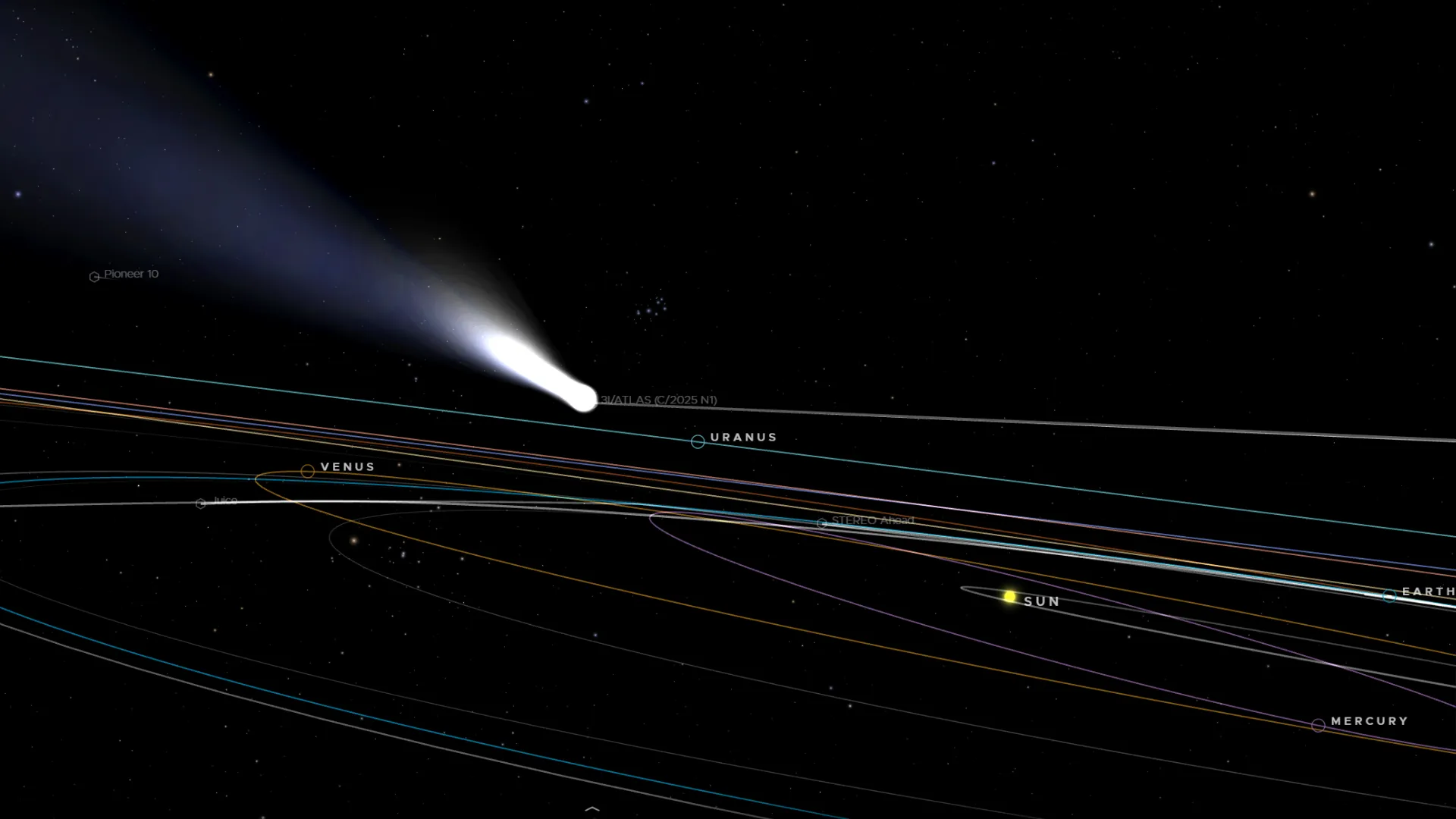
The comet 3I/ATLAS became the third interstellar comet recorded by humanity, following 1I/ʻOumuamua (2017) and 2I/Borisov (2019).
On October 29, it reached its closest point to the Sun, at 1.35 astronomical units (about 202 million kilometers), beginning its transit through the perihelion, where it experiences an extreme increase in temperature that causes the sublimation of ice and the formation of a tail of dust and gas.
An interstellar comet that won’t return: unique trajectory and unprecedented speed
Detected on July 1 by the ATLAS Telescope in Chile, 3I/ATLAS travels at 60 km per second (210,000 km/h), the highest speed ever recorded for an object passing through the Solar System. Its passage is unique and unrepeatable, as it will not return to our orbit.
In comparison, the Earth rotates on its axis at only 30 km per second, highlighting the magnitude of this phenomenon.
Observation from space: ground-based telescopes and probes in action
Although it is currently behind the Sun, preventing its location from Earth, space probes continue to collect data.
The Neil Gehrels Swift Observatory of NASA, led by astronomers from Auburn University, managed to detect hydroxyl gas (OH), a chemical fingerprint of water, through faint ultraviolet light.
This signal allows studying its activity as if it were a comet from the Solar System itself, opening new possibilities for astrobiology and planetary chemistry.
Composition and age: a cosmic time capsule
Preliminary analyses indicate that 3I/ATLAS is 7 billion years old, twice the age of Earth.
Its structure of rock and ice offers a unique opportunity to compare its composition with that of other known celestial bodies and to better understand the stellar formation processes and the distribution of water in the universe.
International cooperation: science without borders
The research is led by NASA and the European Space Agency (ESA), which activated protocols to make all their observation tools available.
This collaboration allowed tracking its trajectory, measuring its activity, and documenting its passage through the perihelion, which ends on October 31, before continuing its interstellar journey.
Next approach: opportunity for ground-based telescopes
In the early days of December, 3I/ATLAS will approach Earth at a distance of 270 million kilometers. Although it will not be visible to the human eye, ground-based telescopes will be able to obtain valuable data about its structure and behavior.
The passage of 3I/ATLAS represents an astronomical milestone that allows science to explore the limits of the Solar System, study interstellar matter, and review theories about the origin of water and life.
Each comet that visits us from other stars is a time capsule, and its study brings us a little closer to understanding our place in the cosmos.



