



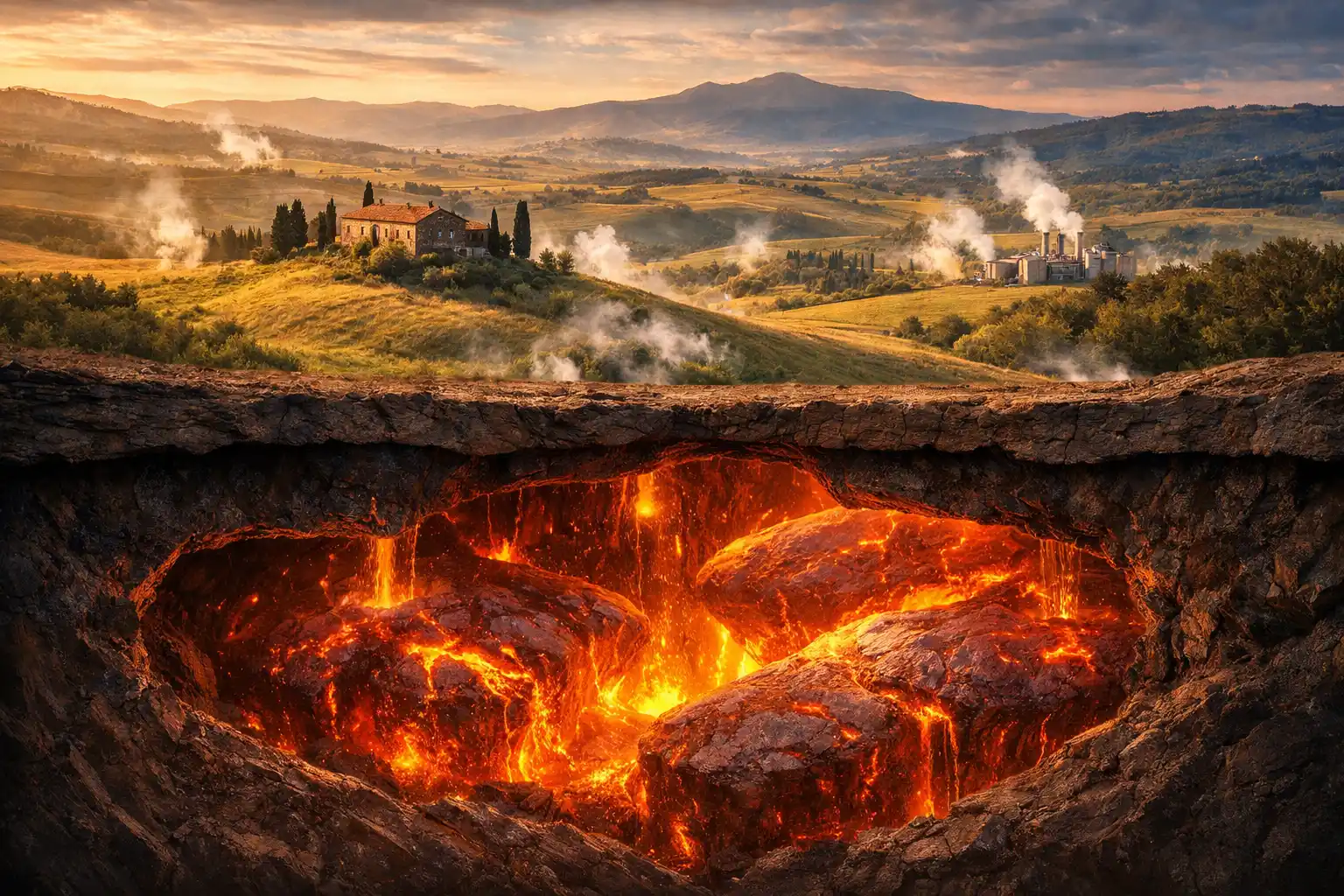
An international team of scientists from the University of Geneva, the National Research Council of Italy (CNR-IGG), and the National Institute of Geophysics and Volcanology (INGV) discovered a reservoir of approximately 6,000 km³ of magma beneath the Tuscany region, located between 8 and 15 kilometers deep in the Larderello and Monte Amiata areas.
The finding, published in Communications Earth & Environment, does not represent an immediate volcanic threat but opens opportunities for geothermal energy and the extraction of lithium and rare earth elements, essential resources for the global energy transition.
Comparison with supervolcanoes
The volume of the Tuscan reservoir is comparable to volcanic systems such as Yellowstone (USA), Toba (Indonesia), or Taupo (New Zealand).
However, unlike these places, no craters, eruptive deposits, or surface deformations have been detected in Tuscany, demonstrating that large accumulations of magma can remain hidden for millions of years without generating visible volcanic activity.
Methodology used
The discovery was made possible through ambient noise tomography, a technique that analyzes natural vibrations generated by the sea, wind, and human activity.
- Seismic sensors capture the waves.
- Areas where the waves move more slowly reveal the presence of partially melted rock.
- The three-dimensional analysis allowed for a detailed reconstruction of the reservoir’s internal geometry.
According to Matteo Lupi, the study coordinator, “we knew this region is geothermally active, but such a large volume of magma, comparable to supervolcanic systems, was not known.”
Energy and economic potential
The Tuscan super-reservoir could boost:
- Large-scale geothermal deposits, harnessing the Earth’s internal heat.
- Extraction of lithium and rare earths, essential for batteries, electronic devices, and low-carbon technologies.
- Consolidation of Tuscany as a European leader in geothermal potential and strategic resources for decarbonization.
Specialists highlight that the combination of geothermal energy and access to critical minerals makes this finding a doubly valuable resource: clean energy and raw materials for the energy transition.
Scientific and environmental impact
The discovery also expands knowledge about magmatic phenomena in seemingly calm regions. The methodology used, which is quick and low-cost, does not generate environmental impact and could be applied in other parts of the world to identify hidden deposits.
According to Gilberto Saccorotti from INGV, this technique “allows for precise and sustainable subsurface exploration,” reinforcing its usefulness in both fundamental research and practical applications.
The discovery of the giant magma reservoir beneath Tuscany represents a key scientific and technological advancement. It not only reveals the existence of a volume comparable to the largest supervolcanoes on the planet but also offers a unique opportunity to harness critical resources in the transition to a low-carbon economy.



