



On the Norwegian island of Spitsbergen, a remote territory of the Arctic, an exceptional fossil site has come to light. The site preserves a detailed image of the return of marine life after a planetary crisis.
The area was already known for its rocks from the beginning of the Age of Dinosaurs. However, this finding surpasses previous ones by showing a complete ecosystem in full reconstruction.
The scale of the discovery is unprecedented: more than 30,000 fossils concentrated in the same environment. The collection allows us to observe how diverse species interacted in a recovering ocean.
The first great expansion of reptiles into the ocean
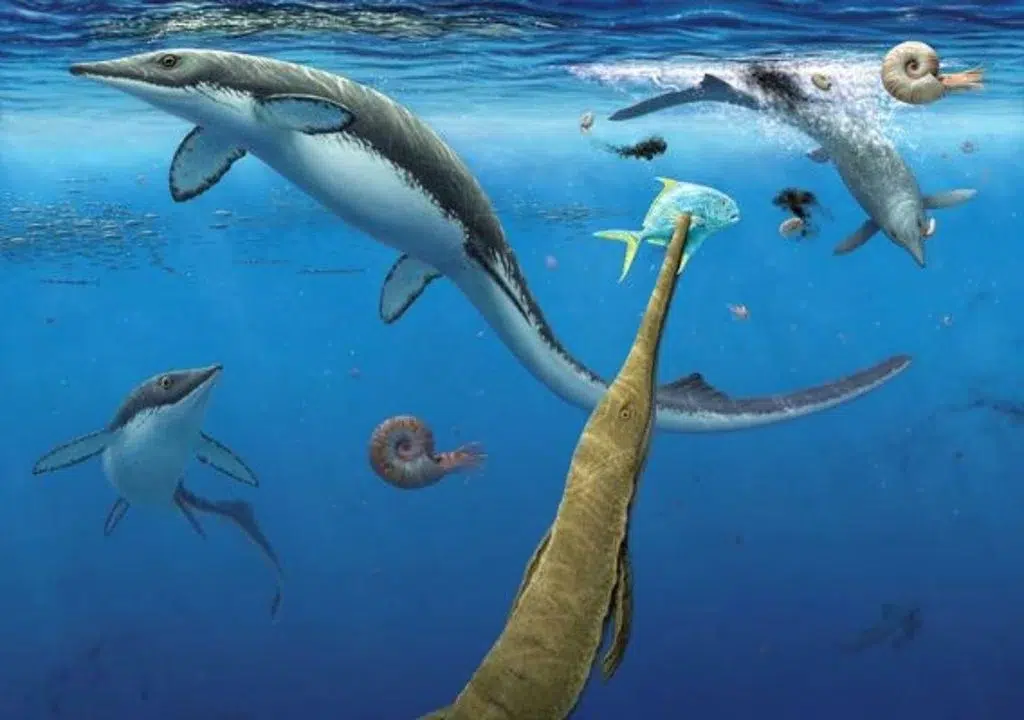
The fossil record reveals a complex marine community that was active a few million years after the global collapse. Fully aquatic reptiles appear alongside sharks and bony fish.
Large marine amphibians and archosauromorphs related to future crocodiles were also identified. This coexistence indicates already established trophic networks.
The collection corresponds to the first radiation of terrestrial vertebrates into the sea after the Permian extinction. A process that occurred earlier and faster than expected.
A complete ecosystem preserved in a brief geological period
The site consists of a dense bone bed exposed on the side of a mountain. Its formation occurred in a short period, improving the precision of the ecological analysis.
Dating indicates an age of 249 million years, just three million after the mass extinction. Even then, there was a remarkable biodiversity.
Among the remains, coprolites were found that allow the reconstruction of diets and feeding relationships. This offers a direct view of the functioning of the ecosystem.
Why these findings are fundamental for science and the environment
The discovery challenges the idea of a slow recovery after major climatic crises. It shows that life can reorganize quickly when new niches arise.
Understanding these processes helps interpret how ecosystems respond to extreme changes. It is a valuable lesson in a context of current environmental alterations.
The site acts as a natural archive of the deep past. Its study provides clues to anticipate the resilience and limits of life on the planet.


