



An international team of scientists aboard the research vessel Falkor (too), operated by the Schmidt Ocean Institute, identified 31 new marine species in deep waters of the South Atlantic off the coast of Brazil.
The campaign, conducted between April 15 and 30, explored the mesopelagic zone, a little-studied ecosystem that extends between 200 and 1,000 meters deep.
This discovery adds to previous expeditions in the Mar del Plata submarine canyon, where scientists from CONICET had recorded 40 new species. A new mission is planned in 2027 off the coast of Chubut.
Identified Species
During the Designing the Future 3 campaign, researchers found:
- An amphipod (a crustacean related to crabs and lobsters).
- A Tomopteris worm, surprising for its speed.
- Nine jellyfish.
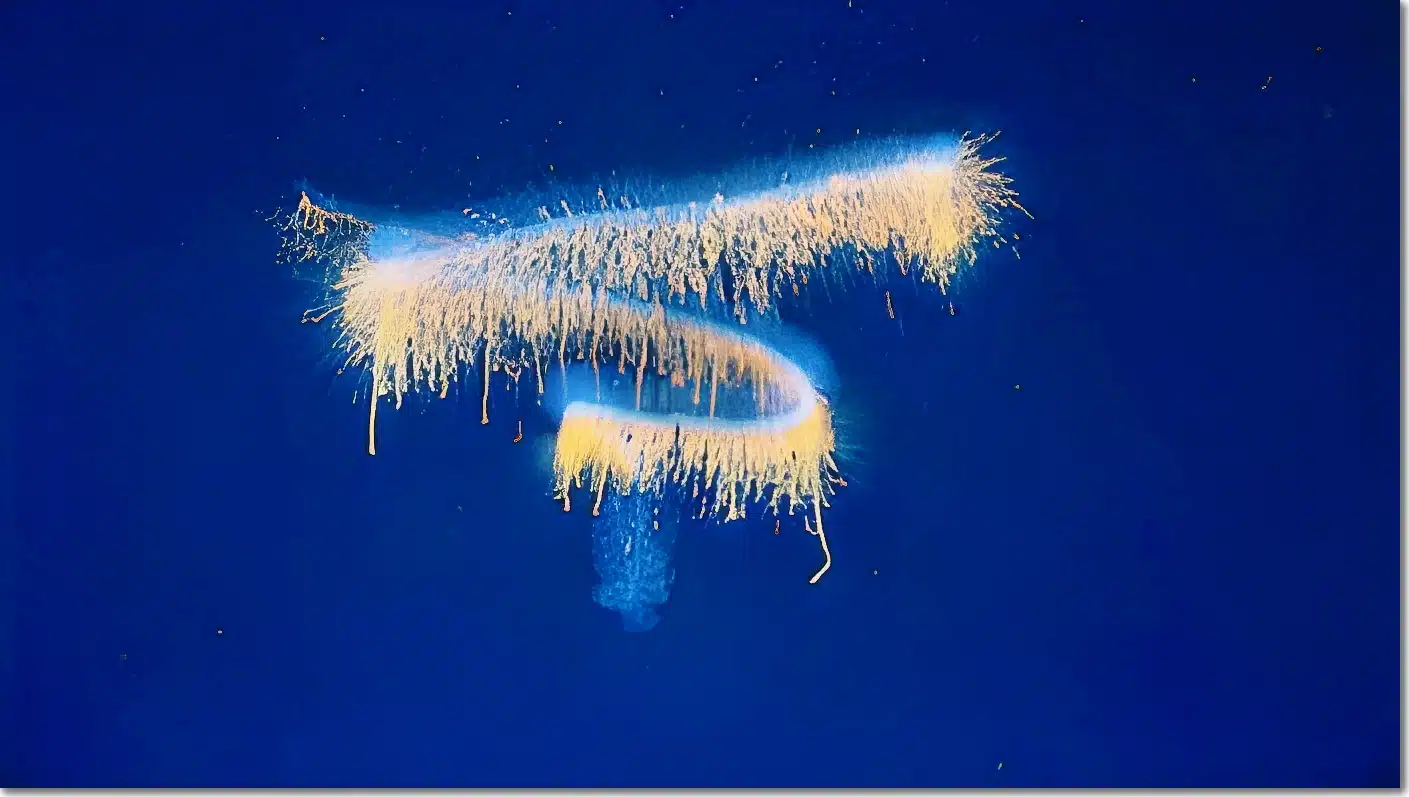
- Seven siphonophores, colonial organisms related to corals.
- Seven ctenophores, known for their shimmering cilia.
- Four larvaceans, animals that build mucus houses.
- Two giant rhizarians, unicellular organisms visible to the naked eye.
Additionally, unprecedented interactions were observed, such as a female octopus (Haliphron atlanticus) devouring a jellyfish at 800 meters deep.
Cutting-edge Technology
The success of the expedition was due to the use of innovative tools:
- DeepPIV and EyeRIS: 3D imaging systems connected to the underwater robot ROV SuBastian.
- JAMSTEC Camera: capable of showing tiny details in soft organisms.
- Squid Microscope: allowed observing live cells in three dimensions at sea.
- Virtual reality: developed by the University of Western Australia.
- Stanford Gravity Machine: reproduces the natural environment of marine microbes.
- Onboard DNA testing: species identification in a matter of days.
Scientific Importance
Chief scientist Karen Osborn, from the Smithsonian National Museum of Natural History, highlighted that the midwater is “the largest habitat on Earth and is full of incredible animals that we are just beginning to understand.”
The executive director of the Schmidt Ocean Institute, Jyotika Virmani, emphasized that the mission demonstrates how advanced technology allows for sophisticated and non-invasive study of marine life.
Connection with Argentina
The Falkor (too) vessel was also a protagonist in the Talud Continental IV expedition in the Mar del Plata canyon, where 40 new species were identified. In 2027, CONICET will launch the Talud Continental V mission, which will explore the Ameghino and Almirante Brown canyons off Chubut, with live streaming of the discoveries.
The discovery of 31 new species in Brazil confirms the importance of collaborative research and the use of cutting-edge technologies to expand knowledge about marine biodiversity.
These expeditions not only reveal the richness of the deep ocean but also provide key information for the conservation and balance of ocean ecosystems.



