



An international team of scientists has managed to decipher how internal friction and bubble formation in magma influence the type of eruption. The research challenges the traditional model that linked explosiveness solely with pressure and gas content.
The results provide an essential tool for predicting eruptive behaviors in active volcanoes. The study focused on explaining why some volcanoes with gas-rich magma produce calm eruptions.
To achieve this, the team combined laboratory experiments with computer models designed to simulate real conditions. Examples like Mount St. Helens and Quizapu allowed for the observation of these dynamics in historical scenarios.
The researchers discovered that the creation and movement of bubbles are more complex processes than previously thought. The friction between the magma and the walls of the conduit generates bubbles even without external pressure changes. This finding alters the approach with which volcanic prediction models are constructed.
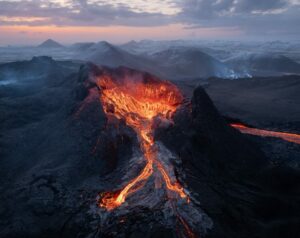
Friction, a hidden force that defines the course of an eruption
The new model highlights that shear forces within the volcano play a central role. In areas near the walls of the conduit, the magma moves more slowly and friction accumulates.
This uneven movement acts as a trigger for the formation of gas bubbles. These initial bubbles create ideal conditions for the emergence of new bubbles in a chain. The process accelerates when the magma has a high gas saturation from its origin.
The experiments revealed that, under these conditions, less friction is needed to repeat the phenomenon. As bubbles form in specific sectors, the gas finds escape routes before reaching the surface.
This can facilitate the magma releasing pressure without triggering a violent explosion. Therefore, some volcanoes with viscous material surprise with calm eruptions and fluid lava.
Implications on eruptive dynamics
The distribution and quantity of bubbles determine how the magma ascends through the volcanic conduit. When the bubbles combine and create channels, the gas is released prematurely. This mechanism reduces internal pressure and completely changes the type of eruption.
The observation of Mount St. Helens in 1980 supports this pattern. Before the great explosion, the volcano exhibited a slow lava flow inside the cone. Only when a landslide enlarged the conduit and reduced the pressure did the detonation occur.
Computer models confirmed that these processes occur especially near the walls of the volcano. There, the viscous magma is subjected to intense shear forces that promote bubble formation. This allows updating the criteria with which eruptive scenarios are evaluated.
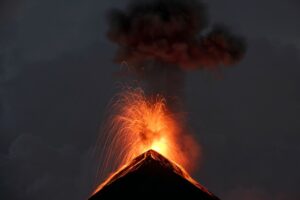
Scientific contribution: how these investigations improve environmental safety
Understanding the internal dynamics of magma allows for more accurate estimation of the risk of an eruption. The data obtained helps differentiate between explosive events and episodes of progressive degassing.
This is key for planning evacuations, monitoring vulnerable areas, and designing early warnings. The work also strengthens models that describe the behavior of volcanoes considered unpredictable.
By incorporating friction and internal movement, a more realistic approach to underground processes is acquired. This improves scientists’ ability to anticipate abrupt changes in volcanic activity.
These advances enhance environmental management in regions where volcanic activity is part of the territory. Additionally, they allow for understanding how pressure, gas, and magma flow will influence nearby ecosystems. Volcanic science thus advances towards more precise instruments to reduce risks and protect communities.



