



Commercial aviation concentrates one of the most complex climate challenges. However, a massive flight analysis reveals an immediate potential for improvement. Thus, without reducing frequencies, air emissions could substantially decrease.
The study examined more than 27 million flights conducted in a single year. From that data, it detected enormous differences in operational efficiency. Therefore, the problem is not flying, but how it is flown.
In this context, the reorganization of fleets and routes appears as key. Moreover, these are measures already available, without waiting for future fuels. In this way, an initial 11% cut is possible immediately.
Operational efficiency: decisions that already exist
The research shows that some flights emit up to 30 times more CO₂ than others. This gap does not respond to extreme distances, but to operational choices. Therefore, optimizing what exists is more effective than previously thought.
The global average was 84.4 grams of CO₂ per kilometer and passenger. However, certain efficient routes drop to about 30 grams. Consequently, replicating these practices would allow for a significant environmental leap.
Thus, the focus shifts from future technology to present management. Better allocation of aircraft and routes can generate rapid changes. Additionally, it reduces costs and fuel consumption at the same time.
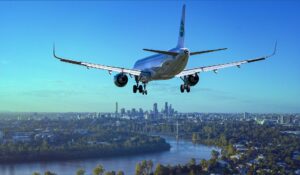
The aircraft model and interior design
The type of aircraft decisively influences the final emissions. According to the analysis, values range between 60 and 360 grams of CO₂. Therefore, renewing fleets with environmental criteria is crucial.
The most efficient models allow for fuel savings of over 25%. Although the entire fleet is not replaced overnight, every decision counts. Thus, prioritizing efficiency over size or luxury becomes strategic.
How seats are distributed also matters. Premium classes can emit up to five times more per passenger. In contrast, denser configurations reduce by up to an additional 57%.
Occupancy: fewer empty flights, fewer emissions
Another key factor is the occupancy rate of flights. On average, planes take off with 79% of their seats occupied. However, raising that figure to 95% would have a direct impact.
Higher occupancy would allow for a reduction of about 16% in emissions. This is achieved by adjusting frequencies and avoiding half-empty routes. Thus, smart management replaces unnecessary expansion.
Combined, these three measures change the global scenario. The total reduction could range between 50% and 75%. Moreover, all without reducing the number of flights.
What airplane emissions produce in the environment
Air emissions are not limited to carbon dioxide. They also release nitrogen oxides that affect air quality. These compounds contribute to the formation of ozone at low altitude.
At high altitude, airplanes generate persistent contrails. These artificial clouds trap heat and reinforce global warming. Therefore, their climatic impact exceeds that of CO₂ alone.
Additionally, the intensive use of fossil fuels pressures ecosystems. Extraction and refining cause indirect damage to soil and water. Reducing emissions implies alleviating that entire environmental chain.
Public policies and regional differences
The analysis also exposes strong contrasts between regions. Some concentrate the least efficient flights on the planet. Others, on the other hand, show better ratios per passenger.
In this scenario, clear regulatory tools are proposed. Efficiency labels, differentiated rates, and carbon intensity limits. Thus, efficiency becomes a real economic incentive.
Finally, a more efficient aviation frees up scarce resources. Sustainable fuels can be used where they contribute the most. In this way, climate change is tackled with concrete and current solutions.



