



Canada could offset at least five times its current annual emissions through targeted reforestation and afforestation at the northern edge of the boreal forest. This strategy relies on the enormous carbon capture capacity of the taiga.
However, the potential is not automatic. It depends on the location, the chosen species, and the initial survival of the planted trees.
Moreover, fire emerges as a decisive variable that can transform a climate gain into a sudden loss.
Scale, territory, and carbon at stake
The analyzed scenarios consider intervening between 6.4 and 32 million hectares in northwestern Canada. In particular, the ecozone Taiga Shield West concentrates the greatest capture possibilities.
Over 75 years, the potential carbon removal ranges between 3.88 and 19.4 gigatons of CO₂ equivalent. This broad range reflects real uncertainties.
Therefore, more than a fixed figure, it is a window of opportunity conditioned by environmental risks.
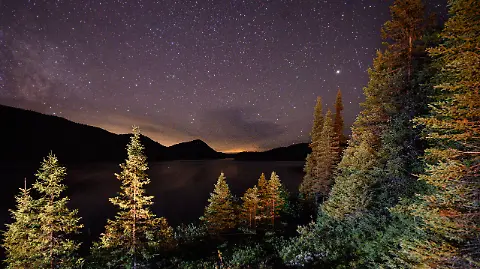
Fire and survival as key factors
The fire return interval defines the final balance. Where fire is frequent, the accumulated carbon is lost before it consolidates.
Added to this is the early mortality of seedlings, especially in the first five years. If survival fails, the climate balance collapses. Thus, planting more does not guarantee better results if the ecological risk of the territory is not managed.
Reforestation, afforestation, and sensitive decisions
Recovering areas that historically were forests usually offers better ecological results. The soil and microclimate are already adapted to support trees.
In contrast, afforesting areas that were never forested can alter wetlands, grasslands, or peatlands with high ecological value. Therefore, the key is not to maximize hectares, but to select sites where the net benefit is real.
Benefits of reforesting with an ecological focus
A well-planned reforestation captures carbon durably and helps meet national climate goals. Additionally, it strengthens the landscape’s resilience to extreme events.
At the same time, it can reduce the severity of fires if combined with active land management. Less fire means less smoke and better public health. It also favors biodiversity when monocultures are avoided and pre-existing ecosystems are respected.

Permafrost, albedo, and landscape governance
In high latitudes, trees can protect the permafrost by insulating the soil, although this effect depends on the type of cover. Therefore, each site requires specific evaluation.
Albedo also matters: more trees on snow reduce reflectance and can counteract part of the climate benefit.
Finally, integrating indigenous knowledge and fire management is key. Without local governance and ecological planning, reforestation loses its meaning.
A possible path, but not automatic
The Canadian boreal edge offers a powerful tool against climate change. However, its success depends on planting better, not just planting more.
When reforestation respects the territory, the climate, and biodiversity, it becomes a real ally of the planet. Otherwise, even green solutions can create new environmental problems.


