



The world’s glaciers are undergoing a period of accelerated transformation, driven by rising temperatures year after year. New research based on nearly a decade of satellite data shows that these ice masses are not only melting: they also change their speed and behavior according to the season.
This seasonal rhythm, which alternates accelerations and decelerations, functions as a sensitive footprint of the climate impact. Where temperatures exceed the freezing point, ice movement intensifies, revealing a growing vulnerability of the glacier system.
The environmental challenge is global. The ice sheets are shrinking at a rate that worries the scientific community, increasing the risks associated with global warming. Understanding their seasonal dynamics is key to anticipating the effects of melting in the coming decade.

How glaciers move and what alters their cycles
The study conducted by researchers from the California Institute of Technology (Caltech) in the United States, published in ‘Science’, shows that glaciers react strongly to seasonal melting. When heat increases, the water that forms on the ice surface seeps to the base. There it raises the pressure and reduces friction, causing the glacier to advance at a higher speed.
This effect does not occur equally in all regions. The glaciers located in temperate zones, where the thermometer exceeds 0 °C, show the most noticeable variations. Their pace can change abruptly at the beginning of the year, when the melting is more intense.
Globally, a relationship is also detected between seasonal variations and year-to-year fluctuations. This suggests that the shape of the glacier and the conditions of the subglacial terrain influence its climate sensitivity. Although it does not imply a long-term change by itself, it does reveal a structural vulnerability that could be amplified under scenarios of sustained warming.
The ecological and climatic impact of retreating glaciers
The accelerated melting of glaciers has profound effects on ecosystems and the climatic balance. The loss of these freshwater reserves reduces the water availability for millions of people who depend on them during dry seasons.
Additionally, the contribution to sea level rise intensifies. Each year, the retreat of ice adds more volume to the oceans, increasing the risk of coastal flooding and erosion in densely populated areas. Added to this are the geological risks: glacial lake overflows, ice detachments, and landslides associated with the weakening of the terrain.
Glaciers also act as thermal regulators. As they disappear, the planet loses reflective surfaces that return solar radiation to space. This exacerbates global warming in a vicious circle that further accelerates melting.
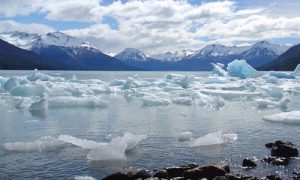
Why it is so dangerous for glaciers to melt
A planet with less ice faces multiple threats. The loss of glaciers alters biodiversity, modifies rivers, affects agricultural production, and compromises the stability of communities that depend on their natural cycles.
High mountain ecosystems, already pressured by drought and thermal change, lose species adapted to the cold. Cities near glacial basins record changes in water availability that affect everything from domestic consumption to hydroelectric generation.
The sustained disappearance of ice also implies a loss of climate memory. Glaciers store information about thousands of years of environmental history, a record that becomes irretrievable as the ice disappears.
A future conditioned by climate
The seasonal pulse of glaciers reveals a disturbing reality: the climate system is already changing faster than many ecosystems can withstand. Although the dynamics of ice are complex, its response to rising temperatures is clear and urgent.
Protecting these natural reserves involves advancing towards emission reduction policies and a deep energy transition. Ice, sensitive and silent, has become one of the most compelling indicators of the planet’s future.



