



48 million years ago, the southwest of Wyoming was neither arid nor windy. During the Eocene, the region was part of a vast system of lakes and rivers, where different species, such as the turtle, inhabited.
This aquatic network was part of the Green River Formation, one of the world’s most significant fossil deposits. The climate was warm and humid, with temperatures higher than today’s.
In this environment, fish, crocodiles, and primitive mammals thrived. Additionally, there were many aquatic reptiles adapted to calm waters.
The Gosiute Lake accumulated fine sediments at its bottom. Over time, these deposits allowed for the preservation of organic remains with remarkable detail.
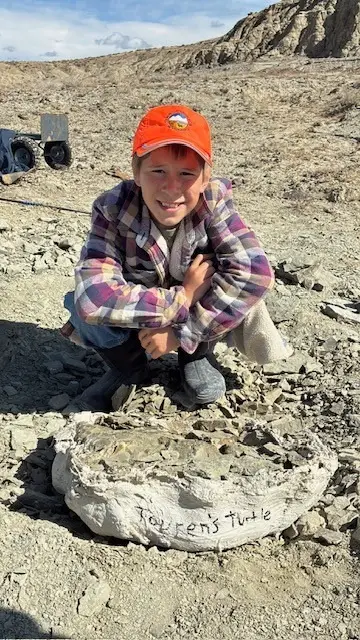
What is known about this turtle species?
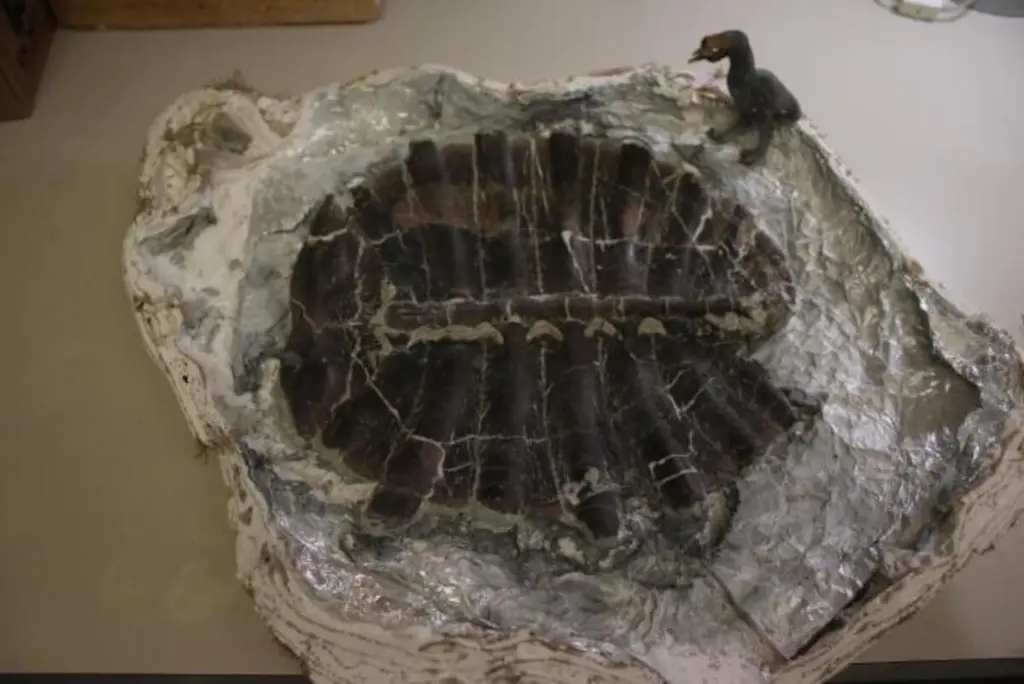
The fossil belongs to a softshell turtle from the Trionychidae family. The specimen preserved almost the entire carapace.
Although no other bones were found, the morphology was sufficient for identification. The flat and flexible shell is characteristic of the group.
These turtles have a reduced bone structure covered by thick skin. Therefore, they move with agility and can bury themselves in sediments. The lineage still exists today in North America, Africa, and Asia. Thus, the finding confirms it was already established in the Eocene.
From an evolutionary perspective, these fossils help trace the reptilian diversification. Especially after the extinction of the dinosaurs millions of years earlier.
From the field to the laboratory: scientific rescue
The specimen was found on public lands managed by the Rock Springs office. Then, specialists documented its exact geological context.
This step is crucial to preserve the scientific value. A fossil without stratigraphic record loses part of its information.
The extraction was carried out with controlled techniques and protective materials. Subsequently, it was transferred to an authorized museum. In the laboratory, technicians removed adhered rock with fine tools. Thus, the internal structures of the shell were exposed.
Each stage was recorded for future research. Fossils are data sources, not mere exhibition objects.
A window into the past climate
The Eocene was characterized by a warmer global climate than today. There were no permanent large ice caps at the poles.
The presence of softshell turtles indicates stable aquatic habitats. These species are sensitive to water temperature.
Therefore, the finding confirms extensive river systems in the region. It also provides data on biodiversity in warm contexts.
The fossils of the Green River Formation allow for detailed reconstructions. Each new specimen expands knowledge about ancient ecosystems of North America.


