



At the southernmost edge of the planet, where the ocean and ice impose extreme conditions, Argentina is advancing in the design of a new polar vessel for logistical support. In this regard, the project seeks to consolidate the national presence in Antarctica through infrastructure adapted to hostile environments.
Furthermore, the initiative is driven by the Ministry of Defense of Argentina along with the Argentine Navy. Therefore, it is a proposal in the design and basic engineering stage, still without advanced construction.
Additionally, the technical development is carried out in cooperation between the state shipyard Tandanor and the Finnish firm Aker Arctic. In this way, local and international capabilities specialized in polar navigation are integrated.

Technical design adapted to extreme conditions
The projected vessel would exceed 130 meters in length and reach about 5,000 tons of displacement. Firstly, it would feature a diesel-electric propulsion system, designed to optimize performance in icy waters.
Likewise, its reinforced hull would allow it to withstand impacts with sea ice. Consequently, the structure would be prepared to operate in conditions typical of polar regions.
On the other hand, the vessel would include basic laboratories on board. In this way, scientific analyses could be facilitated in real-time during campaigns on the white continent.
Project status and current challenges
So far, the project has advanced in the initial phases of technical design. However, the subsequent stages are delayed due to budgetary and administrative issues.
In this context, the lack of funding has limited the continuity of the engineering studies. Therefore, the completion of the vessel will depend on future political and economic decisions.
At the same time, the debate over the role of the Tandanor shipyard adds uncertainty to the development. Consequently, the progress of the project remains subject to structural definitions within the sector.
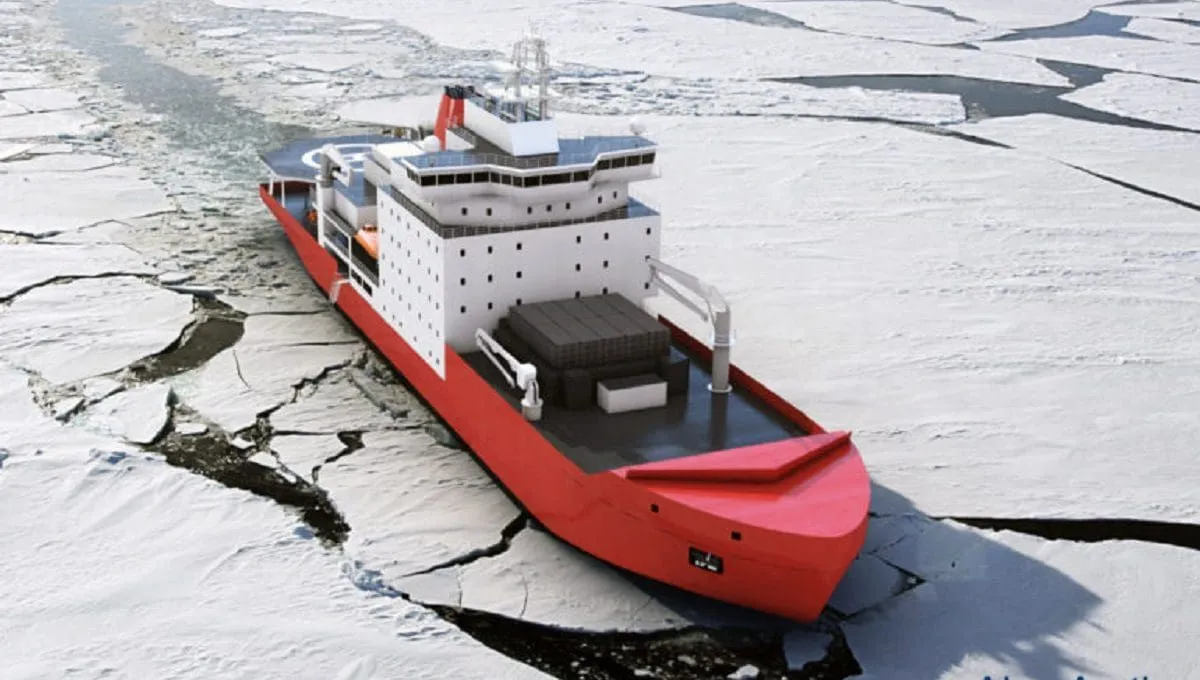
Utility and functionality of the new polar vessel
The incorporation of this vessel would improve the logistics of the Argentine bases in Antarctica. Firstly, it would facilitate the transport of supplies, personnel, and equipment in extreme conditions.
Additionally, it would reduce dependence on foreign means for supply. Consequently, it would strengthen the country’s operational autonomy in the polar region.
On the other hand, its ability to navigate in first-year and moderate ice would extend the annual operational window. In this way, scientific campaigns would be optimized, and efficiency in environmental research would be increased.
Science, sovereignty, and environment on the polar agenda
The new vessel would integrate into the logistical system alongside the ARA Almirante Irízar. In this sense, both would form a key axis to sustain scientific activity in Antarctica.
Furthermore, the initiative reinforces the importance of research in polar ecosystems. Therefore, it contributes to the study of climate change and its global impacts.
Finally, the project represents a strategic commitment for the future. Thus, the combination of technology, science, and territorial presence positions itself as a pillar in the protection of the Antarctic environment.


