



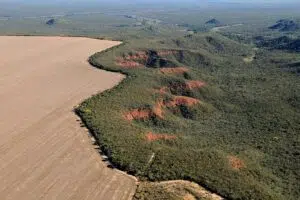
Brazil lost 1.4 billion tons of carbon from the soil in the last 30 years due to the conversion of natural areas into agriculture. The estimate was released by the São Paulo State Research Support Foundation (FAPESP).
The study, published in the journal Nature Communications, indicates that this loss is equivalent to 5.2 billion tons of carbon dioxide equivalent. The figure highlights the climatic impact of land use change.
The research was based on data collected over three decades by the Luiz de Queiroz College of Agriculture at the University of São Paulo (USP), the Brazilian Agricultural Research Corporation (EMBRAPA), and the State University of Ponta Grossa. Together, they analyzed the largest soil carbon database in the country.
The survey gathered 4,290 records from 372 scientific studies. Additionally, it covered all Brazilian biomes and compared natural areas with agricultural zones.

Biomes, agriculture, and conservation practices
The analysis allowed for the calculation of how much carbon each biome accumulates and how much it loses when transformed into agriculture. It also identified which agricultural practices conserve more carbon in the soil.
The results show that certain techniques can significantly reduce losses. Among them are crop rotation and no-till farming.
Integrated systems like the Crop-Livestock-Forest Integration also stand out. These strategies improve vegetation cover and increase the soil’s organic matter.
On the other hand, the recovery of degraded pastures emerges as a key measure. In the coastal strip of the Atlantic Forest alone, there are 20 million hectares with restoration potential.
Recarbonization and climate goals
Researchers estimate that recarbonizing about a third of the agricultural area would be enough for Brazil to meet its Nationally Determined Contribution. This goal, within the framework of the 2015 Paris Agreement, aims to reduce emissions by 59 to 67% by 2035 compared to 2005.
The restoration of carbon in agricultural soils would not only mitigate emissions. It would also strengthen productivity and resilience against droughts.
Consequently, the study provides scientific evidence to guide strategic decisions. The data could support the development of the carbon credit market in Brazil.
Environmental policies and structural challenges
Brazil’s environmental policies have fluctuated in recent years between regulatory advances and setbacks in deforestation control. The protection of biomes such as the Amazon and the Atlantic Forest is central to the national climate balance.
The country has regulatory frameworks like the Forest Code and international commitments made in the Paris Agreement. However, effective implementation depends on sustained oversight and funding.
In this context, evidence on soil carbon reinforces the need for integrated policies. The combination of conservation, sustainable agriculture, and ecological restoration could redefine Brazil’s climate strategy.
Thus, the transition to low-carbon productive models emerges as an urgent challenge. Brazil’s environmental future will be linked to how it manages its soils and strategic biomes.


