



For centuries, the desert was synonymous with loss: it advanced over towns, ruined crops, and turned entire regions into uninhabitable zones. Human responses—walls, trees, barriers—were slow, costly, and often insufficient.
Today, China is testing a radically different strategy: not planting on the desert, but transforming the sand into fertile soil. The experiment is taking place in the Tengger Desert, in the Ningxia Hui Autonomous Region, one of the driest areas in the country. There, desertification is a daily reality, with moving dunes and impossible crops.
The key: cyanobacteria
The project, led by the Shapotou Desert Research Experimental Station (Chinese Academy of Sciences), is based on the use of cyanobacteria, photosynthetic microorganisms capable of surviving in extreme conditions. When there is moisture, they form a biocrust that:
- Binds sand particles.
- Retains water.
- Reduces erosion.
- Creates a microenvironment where other organisms can thrive.
In simple terms, the sand stops behaving like sand and starts behaving like soil.
From laboratory to open field
In 2010, it was demonstrated that cyanobacteria could produce soil under controlled conditions, but they died in the open field. In 2016, applying pressure to introduce them between the sand grains increased survival to 60%, although the method was unfeasible on a large scale.
The solution came with the creation of “soil seeds”: seven selected strains were mixed with organic matter and molded into solid hexagonal blocks. These clods are easy to transport and spread, and upon contact with rain, they awaken, colonize the sand, and form biocrusts resistant to winds of up to 36 km/h.
The process, which would naturally take between five and ten years, is reduced to one year with this technique.
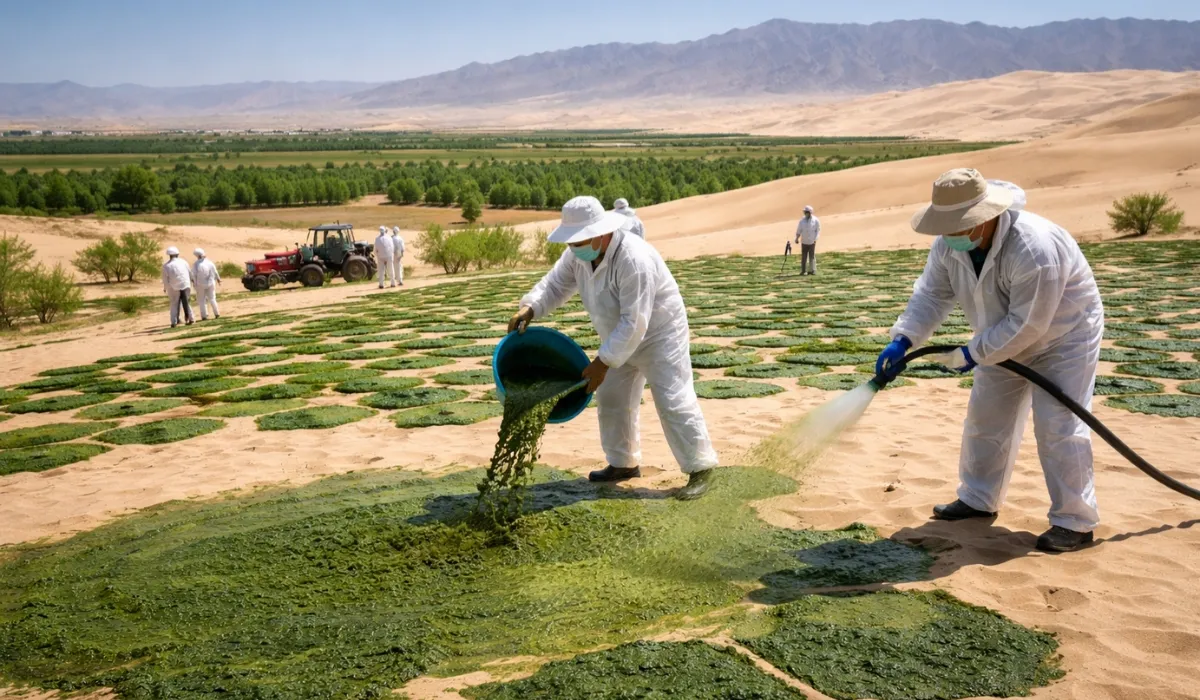
From sand to fertile soil
The transformation is not a patch, but a change of state:
- Loose sand → stable surface → base for cultivation.
The project is integrated into the Great Green Wall of China, the Three-North Shelter Forest Program initiated in 1978, which has already reduced sandstorms and erosion in much of the country. The Shapotou Station was a pioneer in the straw checkerboard method, now replicated worldwide.
Global impact
The Ningxia Hui region plans to treat between 5,333 and 6,667 hectares in the next five years. But the interest transcends borders: Africa, Mongolia, and other arid regions are observing the experiment as a possible solution to their own challenges.
If biotechnology manages to manufacture soil where there was only sand, the impact will be planetary: agriculture, food security, migration, and social stability. The desert ceases to be just a landscape to become a geopolitical factor.
Biological geoengineering
For the first time, microbes are not only used to clean water or produce energy, but to reshape the planet’s surface. It is slow, fragile, and experimental, but real.
If it works on a large scale, it will change an idea that seemed unchangeable: that the desert, once it arrives, never leaves.



