



A study led by Jessica Lueders-Dumont from Boston College, published in Nature, revealed that human activity has reduced the trophic complexity of Caribbean coral reefs by up to 70%.
The team concluded that the length of food chains decreased by 60% to 70%, while the functional diversity of fish fell within a range of 20% to 70%.
This simplification process threatens ecological resilience and compromises the food security of millions of people who depend on these ecosystems.
Importance of Caribbean Coral Reefs
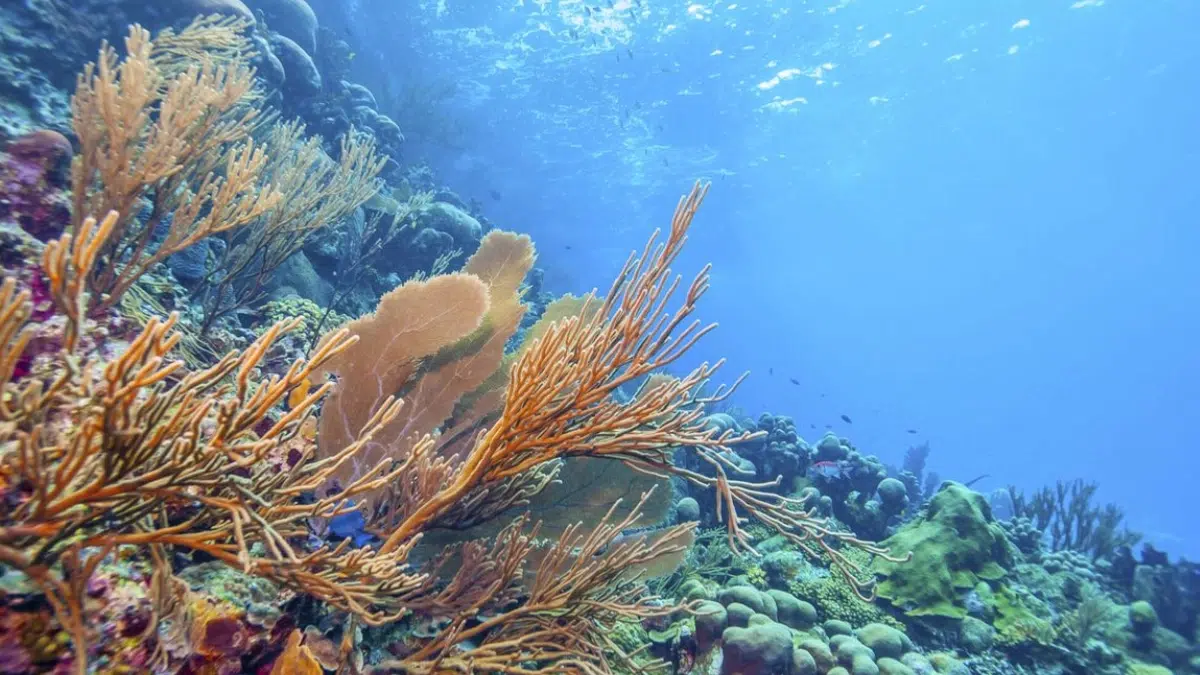
Reefs host at least 25% of marine species and provide coastal protection and food for approximately 1 billion people.
In the Caribbean, more than 50% of coral cover has been lost since the 1970s, reducing their productivity and the ecosystem services they offer.
Paleoecological Methodology
The study used nitrogen isotope analysis in otolith fossils and coral fragments, with samples from Panama (Bocas del Toro) and Dominican Republic (Enriquillo Basin), covering a period of 7,000 years.
A total of 136 fish otoliths and various coral samples were analyzed to assess trophic range and dietary specialization. This approach allowed the reconstruction of the ancient trophic network and comparison of the structure before and after human impact.
Main Results
- In ancient reefs, fish communities consumed a greater variety of resources, promoting stability and resilience.
- In current reefs, diets are homogeneous, with several species resorting to the same food.
- The length of food chains fell by about 60%.
- The functional diversity of fish decreased between 20% and 70%, depending on the region.
- Dominican Republic showed a more marked simplification, attributed to overfishing, loss of coastal habitats, and pollution.
Immediate Ecological Risks
The homogenization and shortening of food chains increase the vulnerability of reefs to abrupt changes.
The loss of functional diversity raises the probability of ecological collapse, as it limits the capacity for response and recovery from disturbances.
Associated Human Factors
The study links trophic simplification with:
- Overfishing.
- Global temperature increase.
- Excess agricultural nutrients.
- Coral habitat deterioration.
- Loss of mangroves and reduction of top predators.
These factors altered the energy flow and affected the entire food web.
Baseline for Conservation
The paleoecological reconstruction allowed establishing an ecological baseline prior to human impact, essential for defining marine conservation and restoration goals. “We can now envision what pristine coral ecosystems really looked like and how we might restore them,” concluded Lueders-Dumont.
Modern coral reefs operate with fewer trophic routes and less functional redundancy than in the past, limiting their resilience to new pressures. The research warns that without urgent conservation measures, the loss of biodiversity and resilience could irreversibly compromise food security and ecological stability in the Caribbean.



