



The Copernicus Climate Change Service (C3S) reported that last May 2026 was the second warmest on record. The global average air surface temperature reached 15.81 ºC, which represents:
- +0.55 ºC compared to the 1990-2020 average.
- +1.42 ºC compared to the pre-industrial period (1850-1900) average.
“May 2026 extended the exceptional global heat, with near-record temperatures both in the atmosphere and the ocean,” said Samantha Burgess, strategic climate lead at the European Centre for Medium-Range Weather Forecasts.
Europe: extreme heat and droughts
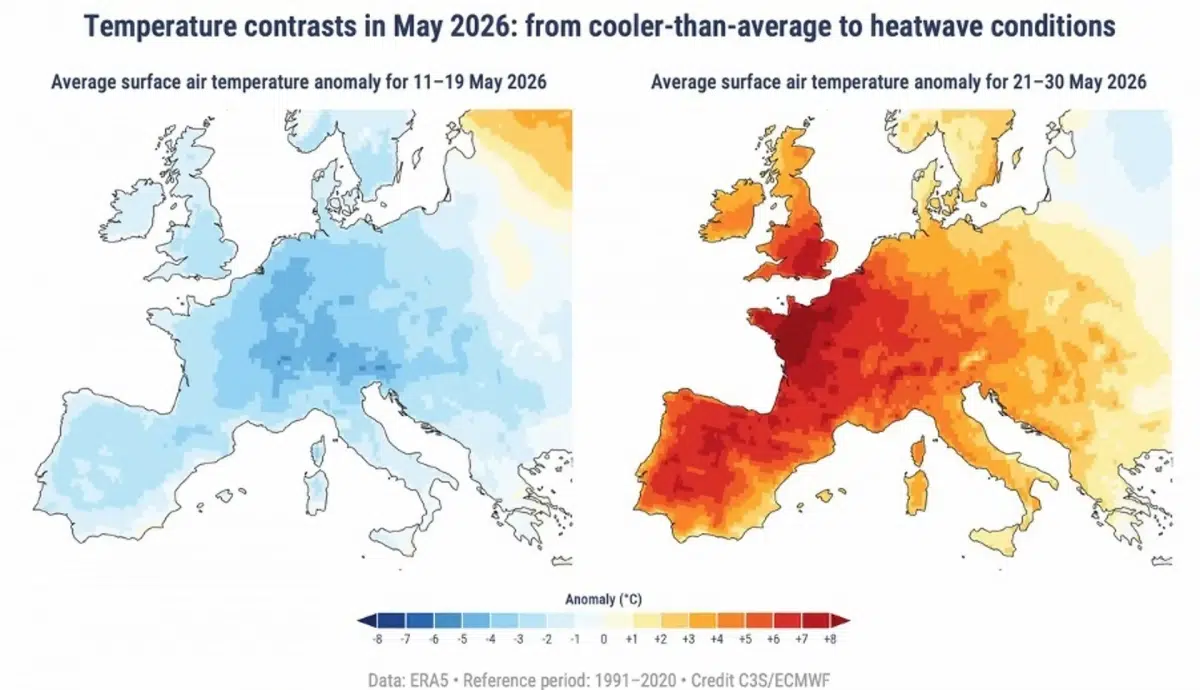
In the European continent, Copernicus highlighted that there was an early and intense heatwave, reflecting how extreme phenomena are becoming the new normal.
- The March-May period was the third hottest spring on record.
- From May 20, temperatures shifted from cooler to warmer than average.
- Western and Central Europe, Italy, and southern Spain experienced drier than usual conditions.
- Other areas like Scandinavia, Iceland, and Western Russia were wetter, although overall the spring was drier than average.
Global precipitation
The Copernicus bulletin also identified contrasts in rainfall:
- Wetter than normal: northern and southeastern North America, parts of northern India and western China, parts of Brazil, southern Africa, and much of Australia.
- Drier than normal: central United States, Central Asia, Madagascar, southwestern Australia, and large regions of South America.
Oceans and poles
- The sea surface temperature reached 20.90 ºC, the second highest value for May, only behind 2024 (20.93 ºC).
- The Tropical Pacific maintained exceptionally high temperatures, while the Equatorial Pacific was moving towards El Niño conditions.
- In the Arctic, ice extent was 4% lower than average, the fourth lowest record for May.
- In the Antarctic, the ice surface was 9% lower than average, the seventh lowest record for this month.
The second warmest May in history confirms the trend of sustained global heat and the acceleration of extreme phenomena.
These data reinforce the urgency of mitigation and adaptation policies in the face of climate change, which already impacts biodiversity, food security, and the daily lives of millions of people.



