



A study published in Scientific Reports reconstructed the evolution of the gravitational depression under Antarctica over the last 70 million years. The research, led by Petar Glišović and Alessandro M. Forte, used seismic data and physical simulations to explain how Earth’s internal processes gave rise to this anomaly and how it relates to the formation of glaciers and sea level variations.
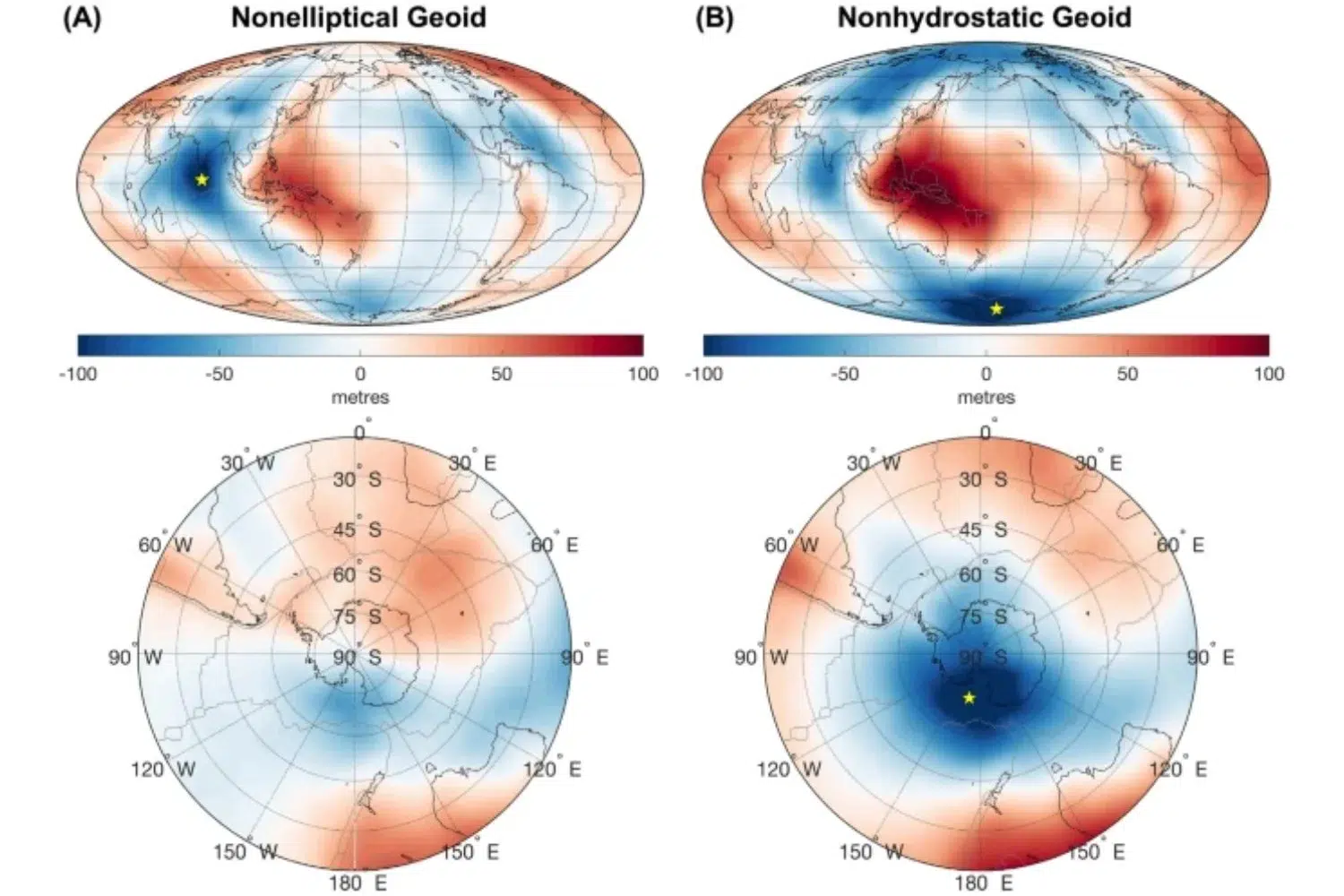
The force of gravity is not uniform across the planet: it depends on the distribution of masses within the Earth and the shape of the Earth. In Antarctica, models show one of the areas with the lowest gravity, which translates into a depression of the geoid, the surface that reflects variations in the gravitational field.
Historical evolution of the gravitational depression
The analysis revealed that the geoid depression under Antarctica:
- Persisted for at least 70 million years.
- At the beginning of the Cenozoic, it was located in the South Atlantic.
- Between 40 and 30 million years ago, it moved towards the current Antarctic region.
- For the last 35 million years, its magnitude increased by 30%, coinciding with a change in Earth’s axis of rotation, identified as True Polar Wander.
Internal processes of the Earth’s mantle
The reconstruction of mantle flow indicates that:
- Originally, the anomaly was due to density differences in the deep layers of the mantle (30–50% of the total intensity).
- In the last 35 million years, the more superficial layers of the mantle have gained prominence, intensifying the depression.
- A stream of hot, less dense material has been rising from the depths, active for 70 million years, elevating the ground beneath the center of the continent.
This internal movement is related to the presence of mountains hidden beneath the ice and the onset of the formation of the large Antarctic glaciers about 34 million years ago.
Innovative methodology
The scientists applied the back-and-forth nudging (BFN) technique, which allows simulating mantle movements backward and forward in time. To do this, they combined:
- Seismic data from earthquakes.
- Information on tectonic plate movement.
- Physical properties of minerals beneath the surface.
The models showed that, beyond small variations, the gravitational depression followed a persistent and defined pattern.
Impact on sea level and climate
Fluctuations in gravitational depression affect the relative height of sea level in the region, influencing the conditions for the formation and growth of ice sheets. This directly connects Earth’s internal processes with the climatic evolution of Antarctica.
According to Forte, the goal is to answer a big question: “How is our climate connected to what happens inside the planet?”.
The study provides new clues about how Earth’s mantle movements influence climate and the surface. The gravitational depression under Antarctica, active for millions of years, not only explains part of the continent’s geological history but also helps to understand how Earth’s internal processes condition glacier dynamics and sea level.


