



Survival against an increasingly extreme planet does not depend solely on storms or droughts. The Global Adaptation Initiative of the University of Notre Dame created ND-GAIN, a tool that combines vulnerability and readiness to show which countries can better face the future.
The index analyzes exposure to climate change and each nation’s ability to leverage adaptation investments. The result is a global matrix that ranks 182 countries based on these critical factors.
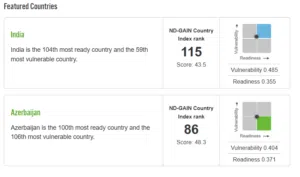
The map divides nations according to their level of risk, using climate vulnerability and institutional readiness as axes. In the green quadrant are the countries with low vulnerability and high readiness, considered the most capable of adapting.
At the opposite end are countries with high vulnerability and low readiness, where urgency is highest and resources are insufficient.
Vulnerability: how much climate change can affect
ND-GAIN assesses vulnerability through six essential sectors for life and the environment. Food production, water availability, and public health are central indicators, along with ecosystem integrity and human habitat.
It also analyzes risks to energy infrastructure, transportation, and exposure to rising sea levels. Additionally, the index also measures countries’ ability to transform investments into effective adaptation measures.
It evaluates political stability, the economic climate, and regulatory quality, key elements for attracting financing. Social readiness —education, equity, and innovation— determines if the population can implement sustainable responses.
Who are better off and who face greater risks
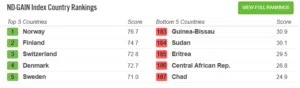
Nordic countries and some stable economies lead the green quadrant, combining low vulnerability and high levels of readiness. Norway, Finland, and Switzerland appear among the most capable of adapting to challenging climate scenarios.
In contrast, nations like Chad, Central African Republic, or Eritrea are among the most exposed and with the least response capacity. The index allows identifying which countries need urgent support and which can lead resilience strategies.
It also helps guide investments towards regions where adaptation will offer greater social impact and environmental benefits. Its comprehensive approach provides clarity on how the climate crisis, infrastructure, governance, and human development interact.


