



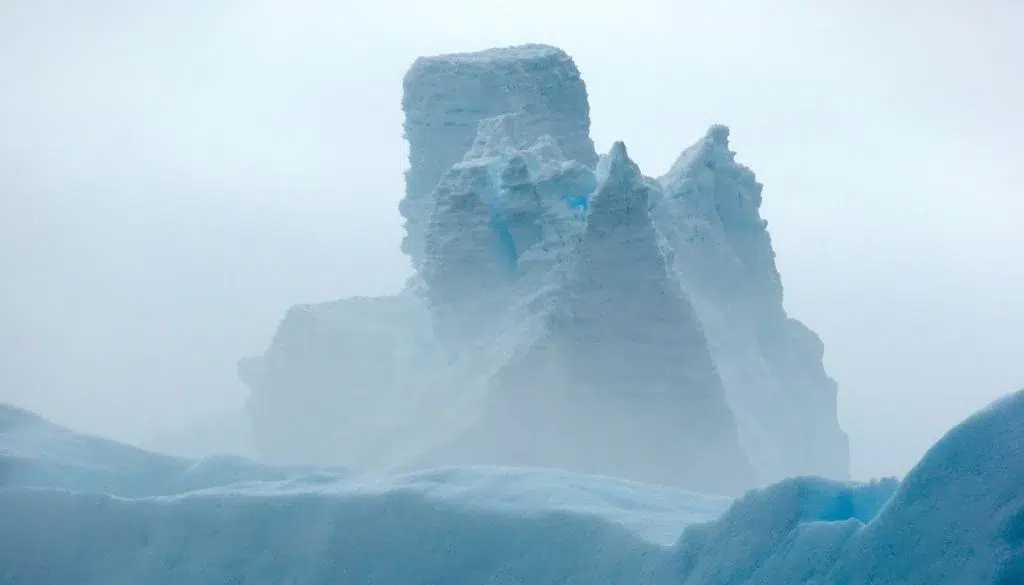
At the southernmost tip of the planet, enormous masses of ice slowly advance over the ocean, marking silent yet decisive changes. The megaicebergs A23a and A76a, with dimensions surpassing large cities, traverse Antarctic waters while releasing fresh water and nutrients in their melting process.
In this context, melting does not solely imply a loss of ice. On the contrary, it also activates ecological processes that influence marine productivity. However, recent research shows that not all these giants have the same environmental impact.
Likewise, the comparative analysis between both ice blocks reveals key differences in their interaction with the ocean. This opens new questions about their role in the climatic balance and carbon absorption.
Marine fertilization: between biological boost and ecological uncertainty
As the megaicebergs move, they release essential minerals that favor the growth of phytoplankton. This microorganism forms the base of the marine food chain and plays a central role in capturing carbon dioxide.
However, the observed results are not uniform. While A76a generated significant biological blooms in its surroundings, A23a did not show significant effects in the surrounding waters.
Consequently, this disparity modifies the previous perception of these phenomena. It is no longer a homogeneous process, but variable dynamics that depend on the history, composition, and trajectory of each iceberg.
History and journey: factors conditioning their environmental impact
The differential behavior between both megaicebergs is explained, in part, by their origin and movement. A23a remained trapped in the Weddell Sea for decades, which would have reduced its nutrient load before coming into contact with open waters.
In contrast, A76a followed a more direct path north after recently breaking off. This allowed it to retain a greater amount of minerals in its outer layers.
Additionally, oceanic processes such as upwelling, which facilitates the rise of nutrients from deep waters, play a role. This combination enhances fertilization in certain cases, but not in all.

What is a megaiceberg and why is its study key to the climate?
A megaiceberg is a floating mass of ice of exceptional dimensions, generally calved from Antarctic ice shelves, whose surface can cover hundreds or thousands of square kilometers.
These giant blocks not only store large volumes of fresh water but also actively interact with the ocean. Their movement modifies currents, temperatures, and nutrient availability.
Therefore, understanding their behavior is fundamental. In particular, it allows for the improvement of climate models and anticipating how the ocean’s capacity to absorb carbon will vary in a global warming scenario.
Implications for the future of the ocean and climate change
The increase in global temperatures suggests that these megaicebergs will become more frequent. Consequently, their influence on marine ecosystems could intensify in the coming decades.
However, evidence indicates that their impact is not linear or predictable. While some promote marine life, others barely generate detectable changes.
Thus, science faces a growing challenge: deciphering the variables that determine these behaviors. Only then will it be possible to understand with greater precision the role of the oceans in the regulation of the global climate.
Ultimately, these giants of ice not only reflect the effects of climate change but also actively participate in its dynamics, becoming key pieces of a complex and constantly transforming environmental system.


