



A group of climbers identified a series of fossil footprints on a rock wall of Monte Cònero, Italy, which drew attention due to their arrangement and similarity to previously found tracks in the area.
After contacting geologist Paolo Sandroni and the director of the Coldigioco Geological Observatory, Alessandro Montanari, an investigation was launched, culminating in the publication of the results in the scientific journal Cretaceous Research in November 2025.
Scientific Interpretation
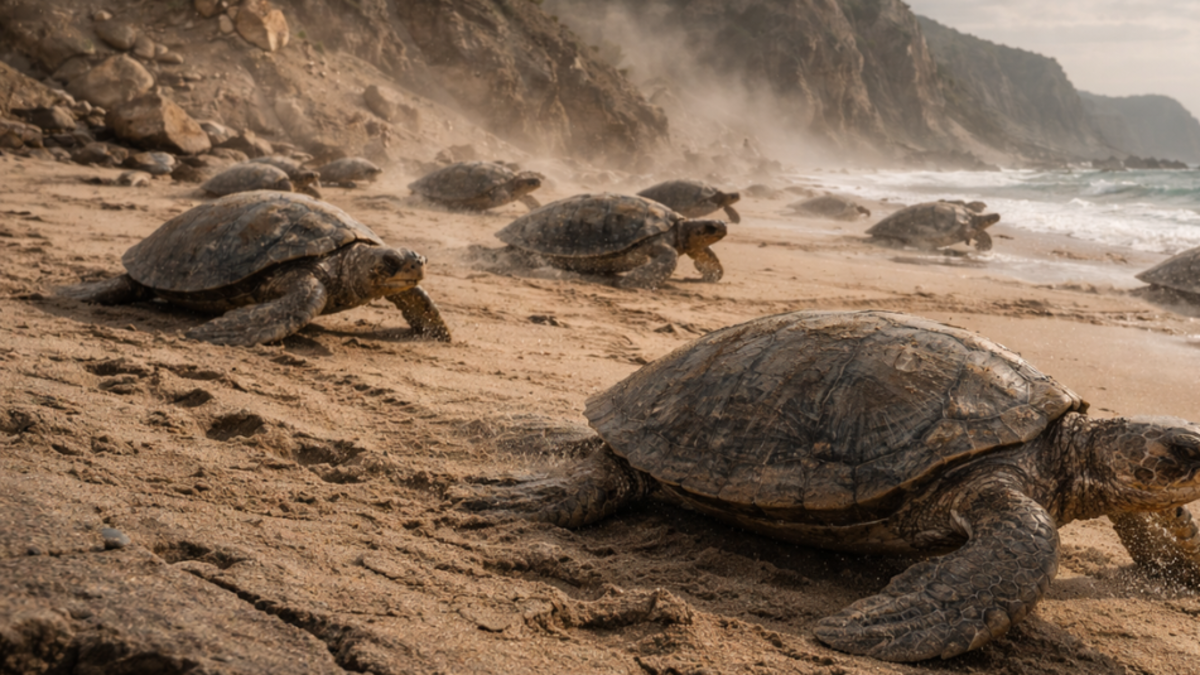
The footprints were attributed to marine turtles that would have fled simultaneously about 79 million years ago, during the Cretaceous period. Geological analysis determined that the marks were preserved in the Scaglia Rossa limestone formation, a deep marine deposit that preserves sedimentation records over millions of years.
According to Montanari, the area that is now part of a mountain was then a seabed. The footprints would have been sealed by a submarine mud avalanche triggered by an earthquake, which allowed their preservation. Under normal conditions, marine currents would have erased any trace.
The Seismic Hypothesis
The geological context supports the idea that a submarine earthquake generated an avalanche that covered the footprints. Microscopic examination of the rocks revealed microfossils of deep-sea organisms, reinforcing the hypothesis. Researchers argue that the only vertebrates capable of leaving such impressions in that environment would be marine reptiles like turtles.
However, paleontologist Michael Benton warns that there are still doubts about the exact authorship of the marks, so additional studies are needed to confirm the interpretation.
Scientific Value of the Discovery
The discovery provides key information on how marine species reacted to natural disasters during the Cretaceous. It also offers data on the dynamics of marine ecosystems in an era dominated by large reptiles and dinosaurs.
Experts highlight that this evidence helps to better understand the patterns of animal behavior in response to abrupt environmental changes, demonstrating that geological phenomena like earthquakes already influenced fauna behavior millions of years ago.
The Role of Amateurs
The finding underscores the importance of accidental discoveries and the role that amateurs can play in identifying new fossil sites. In this case, the initial observation by the climbers was crucial to opening a line of scientific research with international impact.
The fossil footprints of Monte Cònero represent a unique testimony of the interaction between geological phenomena and animal behavior in the Cretaceous. Although there are still open questions about the exact species that produced them, the finding reinforces the idea that earthquakes and other natural events shaped marine life from ancient times.


