



The space race faces a new environmental challenge: the accumulation of debris in orbit. In response to this scenario, Kyoto University and Sumitomo Forestry developed an innovative proposal based on natural materials: the first wooden satellite.
The increase in satellites and devices sent into space multiplies the generation of space debris. Consequently, the metallic debris that reenters the atmosphere releases pollutant particles.
The LignoSat project emerges as a response to this structural problem. Thus, it proposes replacing metallic components with treated wood adapted to extreme conditions.
Moreover, the current technological context, with artificial intelligence and robots like Curiosity, expands the human presence in space. Therefore, the need for sustainable solutions becomes increasingly urgent.
The problem of metal and oxide dust in the atmosphere
The traditional satellites are mainly composed of metals. When their useful life ends, these materials disintegrate upon reentering the atmosphere.
During this process, they release aluminum oxide in the form of fine dust. This residue can remain suspended for years and alter atmospheric dynamics.
Although the impact is still being studied, scientists warn that the massive accumulation could generate adverse effects. Consequently, reducing the metallic load in orbit becomes an environmental priority.
The approach of Kyoto University and Sumitomo Forestry directly targets this source of pollution. Thus, replacing metals with wood aims to avoid persistent emissions.
An ecological solution: the wooden satellite
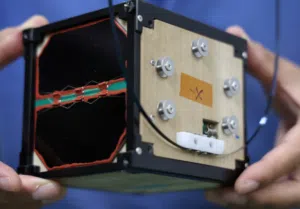
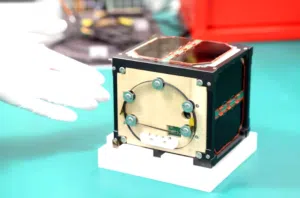
Japan launched a cubic satellite made entirely of magnolia wood. This material was selected after space exposure tests for a year.
In the absence of oxygen, the wood does not burn or rot. Additionally, it showed stability against extreme thermal variations between -125 °C and 125 °C.
Unlike metal, which expands and contracts with abruptness, the chosen wood maintains its shape. Therefore, it offers structural resistance in orbital conditions.
If this model is widely adopted, the wooden satellites would decompose upon reentry, releasing mainly water vapor and minimal amounts of carbon dioxide.
What are the environmental benefits of the material change?
The main benefit is the reduction of aluminum oxide dust in the atmosphere. Thus, the risk of forming pollutant layers around the planet would be minimized.
Additionally, the wood comes from sustainable forest management. This connects the space industry with responsible practices on Earth.
Another key aspect is the biodegradability of the material. Instead of generating persistent waste, the satellite integrates less aggressively into the atmospheric cycle.
Finally, the LignoSat project demonstrates that innovation and nature can coexist. Consequently, it opens a new stage where space exploration also takes on concrete environmental commitments.


