



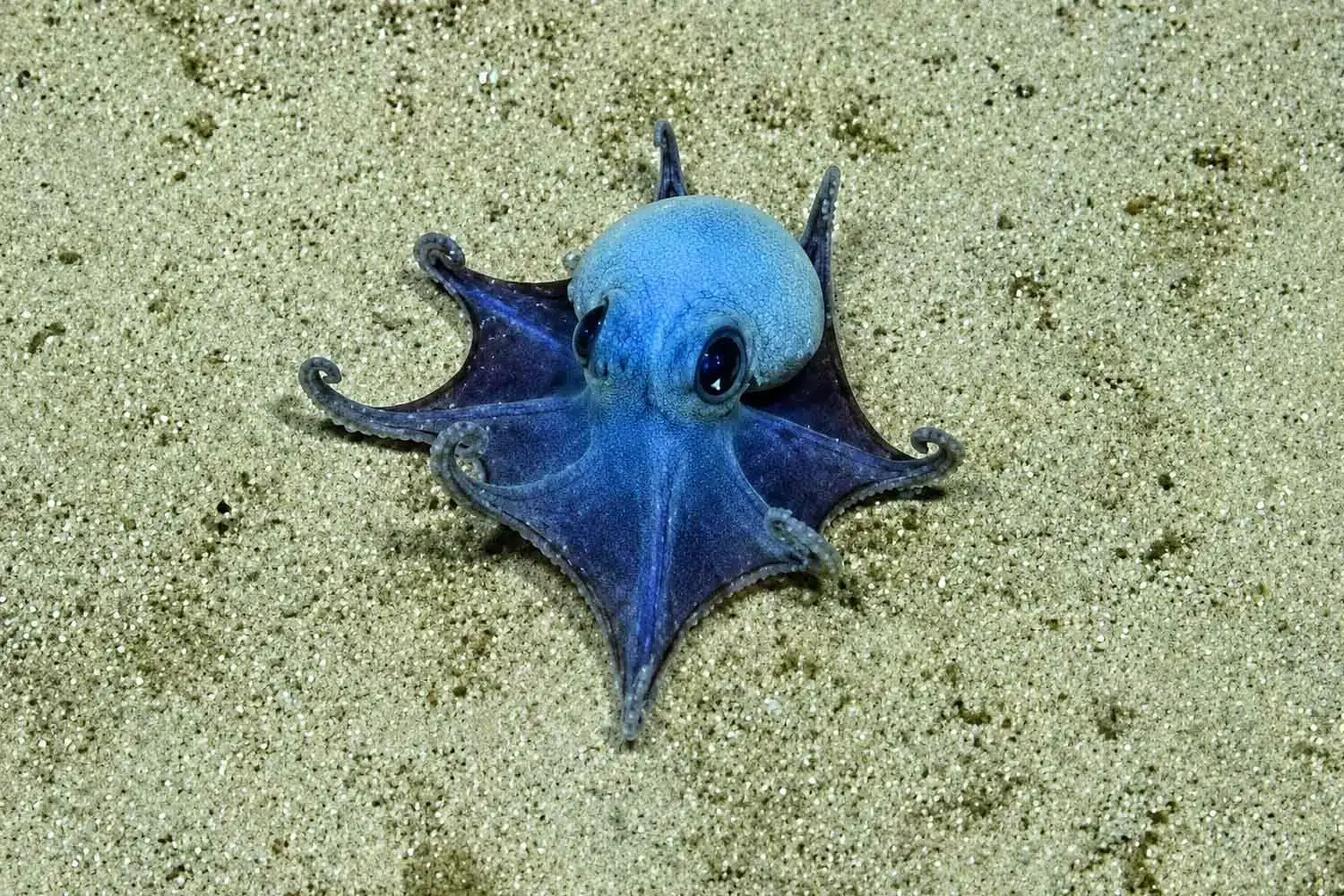
A team of researchers detected at 1,773 meters deep in the Galapagos Marine Reserve a tiny blue octopus the size of a golf ball.
Named Microeledone galapagensis, this specimen was recorded by cameras of the remotely operated submarine E/V Nautilus during a scientific expedition.
The specialists from the Charles Darwin Foundation (CDF) celebrated the discovery in real-time, expressing their excitement about the uniqueness of the animal. Subsequently, the specimen was sent to the Field Museum in Chicago, where researcher Janet Voight confirmed it was a new species.
Unique Characteristics
The Microeledone galapagensis belongs to the family Megaleledonidae, whose members usually inhabit the Southern Ocean and are characterized by their large size. This discovery requires a revision of what was known about the group:
- Short and robust tentacles with a single row of suckers.
- Distinctive coloration: light blue on the dorsal side and dark violet on the ventral side.
- Defensive adaptation: uses its dark membrane to cover bioluminescent prey and avoid attracting predators.
Scientific Innovation in Its Study
To preserve the only collected specimen, the researchers avoided traditional dissection and resorted to 3D computed tomography.
This method allowed them to analyze its internal anatomy without damaging it, marking a milestone in the research of marine invertebrates.
Evolutionary and Ecological Importance
The discovery has scientific relevance in several aspects:
- Evolutionary link: confirms that species of the Megaleledonidae family can adapt to latitudes other than Antarctica.
- Abyssal adaptation: its coloration and defensive behavior reveal unique survival strategies in deep waters.
- Marine conservation: reaffirms that the Galapagos Marine Reserve is a living laboratory of biodiversity, with ecosystems still unexplored.
Context of Recent Discoveries
Janet Voight recalled that it is not uncommon to find new species of octopuses in little-explored deep waters. In 2023, similar specimens were recorded in the Pacific off the coast of Costa Rica. These findings reinforce the idea that the oceans harbor a still unknown diversity and that each expedition can reveal unprecedented species.
The discovery of Microeledone galapagensis not only expands knowledge about octopuses but also underscores the importance of protecting deep marine ecosystems.
The combination of advanced technology, international cooperation, and conservation makes the Galapagos an epicenter of marine science and a reminder that there is still much to explore beneath the planet’s waters.


