



An international team of scientists confirmed the existence of a **new species of green anaconda** in [the Ecuadorian jungle](https://noticiasambientales.com/ciencia/descubren-dos-nuevas-especies-de-aranas-en-la-amazonia-ecuatoriana-y-se-enriquece-el-registro-biologico-del-pais/).
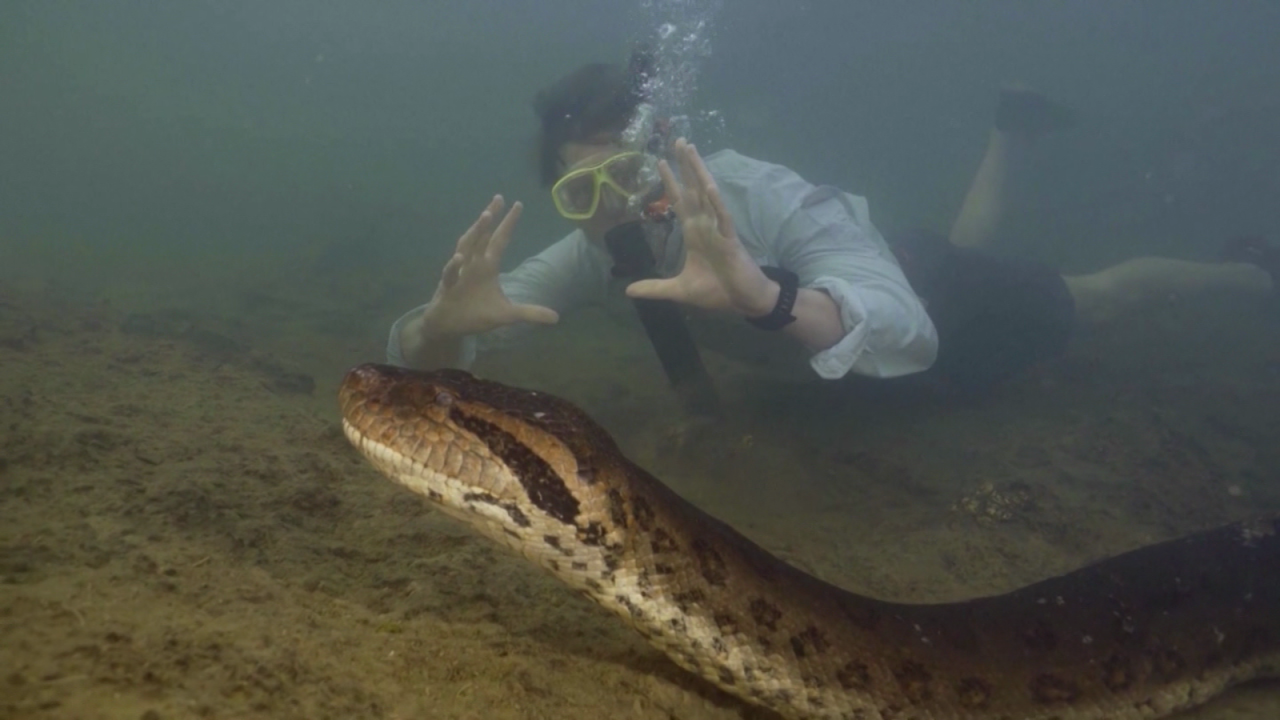
The specimen, **6.3 meters long and weighing over 200 kilos**, was identified during an expedition in the **Bameno region**, within the **Waorani indigenous territory**, one of the most unexplored areas of the **Amazon**.
The snake was named **Eunectes akayima**, and represents the **fifth recognized species of the genus**. Its discovery marks a before and after in **South American herpetology**. This is due to its physical characteristics and genetic differences compared to the **traditional green anaconda (Eunectes murinus)**.
## Scientific research and media involvement
The expedition was led by the toxicology specialist **Bryan Fry** from the **University of Queensland**, in collaboration with scientific teams from **Australia, the United States, and Ecuador**.
During the survey, genetic samples, photographs, and field observations were taken, with the participation of actor **Will Smith**, who was filming a documentary for **National Geographic**.
## Comparative genetics and evolutionary differentiation
Genetic analysis showed that **Eunectes akayima** differs by **5.5%** from **Eunectes murinus**, which [surprised the scientific community](https://noticiasambientales.com/medio-ambiente/descubrimiento-historico-en-china-hallan-dos-ejemplares-de-un-arbol-colosal-que-se-creia-extinto-desde-hace-decadas/). To put it into perspective, this difference exceeds that between **Homo sapiens and chimpanzees**. The species would have **diverged approximately 10 million years ago**, explaining their **separate geographical distributions**.
According to the scientific journal **Diversity**, supported by the [**Butantan Institute**](https://butantan.gov.br/) and the publication **The Conversation**, it was determined that **E. akayima** inhabits **Ecuador, Colombia, Venezuela, Suriname, Guyana, and Trinidad**, while **E. murinus** is found in **Brazil, Peru, Bolivia, and French Guiana**.
## Colossal size and hunting strategy
Although not as long as the **reticulated python**, which can reach **9.7 meters**, this new anaconda is the **most robust in terms of body mass**. Females can exceed **200 kilos**, making it one of the **most feared predators in the Amazon ecosystem**.
It is not venomous, but its hunting technique is lethal: **it wraps around the prey and applies pressure** until its circulation stops, and then consumes it. It feeds on **fish, birds, mammals, and amphibians**, in environments of **dense vegetation and murky waters**, where it camouflages effectively.
## Ancestral knowledge and biological mystery
The existence of this species coincides with the **indigenous legends** that narrate the presence of giant snakes in the region. However, until now, there were **no formal scientific records** to support such stories.
The discovery reinforces the idea that there is still **much to learn about Amazonian biodiversity**, especially in remote and culturally valuable areas.



