



After overcoming a highly competitive selection process, researchers from the **CONICET** lead the campaign [**”Underwater Oases of Mar del Plata Canyon: Continental Slope IV”**](https://noticiasambientales.com/residuos/plastico-en-el-mar-un-hallazgo-impactante-en-la-transmision-cientifica-en-vivo-del-canon-submarino-de-mar-del-plata/), in collaboration with the prestigious **Schmidt Ocean Institute**. The mission takes place in the **Mar del Plata Submarine Canyon**, a region of **high biodiversity and limited exploration** in the **southwestern Atlantic**.
For the first time in Argentine waters, the **ROV SuBastian** is being used, a remotely operated vehicle capable of **capturing ultra-high-definition images** and **collecting samples without altering the environment**.
The expedition is carried out aboard the research vessel **Falkor (too)**, equipped with state-of-the-art oceanographic technology, and is broadcast live on YouTube, featuring images from **depths of up to 3,900 meters**.
## A key ecosystem on the border of ocean currents
Located off the coast of Buenos Aires, the **Mar del Plata Submarine Canyon** lies on the boundary between the **warm Brazil Current** and the **cold Malvinas Current**, a **strategic biogeographical frontier** for the southern Atlantic.
Throughout the campaign, the scientific team analyzes sampling stations at great depths to study the [**distribution of species**](https://noticiasambientales.com/animales/biodiversidad-marina-en-chubut-asi-es-el-refugio-oculto-del-lobo-marino-mas-esquivo-de-argentina/) and their relationship with **environmental, topographic, and oceanographic variables**.
## An interdisciplinary team with national reach
The expedition brings together over **30 Argentine scientists**, mostly from **CONICET**, from institutions such as:
– **MACN (Argentine Museum of Natural Sciences)**
– **IBIOMAR (Institute of Marine Organism Biology)**
– **IIMyC (Institute of Marine and Coastal Research, UNMDP)**
– **IBBEA (UBA-CONICET)**
– **CADIC (Southern Center for Scientific Research)**
– **IDEA (Institute of Animal Diversity and Ecology, UNC)**
Researchers from the **National Universities of Buenos Aires, Córdoba, La Plata, and Mar del Plata** also participate, forming a national scientific network.
## Submarine technology and unexpected discoveries
The chief scientist of the expedition, **Daniel Lauretta (MACN-CONICET)**, highlights the value of the **ROV SuBastian**:
“It’s like having a submarine with super-sensitive eyes. We are already seeing animals never recorded in this area and landscapes that seem from another planet.”
The technology allows for **exploring vulnerable habitats**, detecting **marine debris and microplastics**, studying **benthic biodiversity**, analyzing **environmental DNA**, and understanding the **sediment dynamics and blue carbon**.
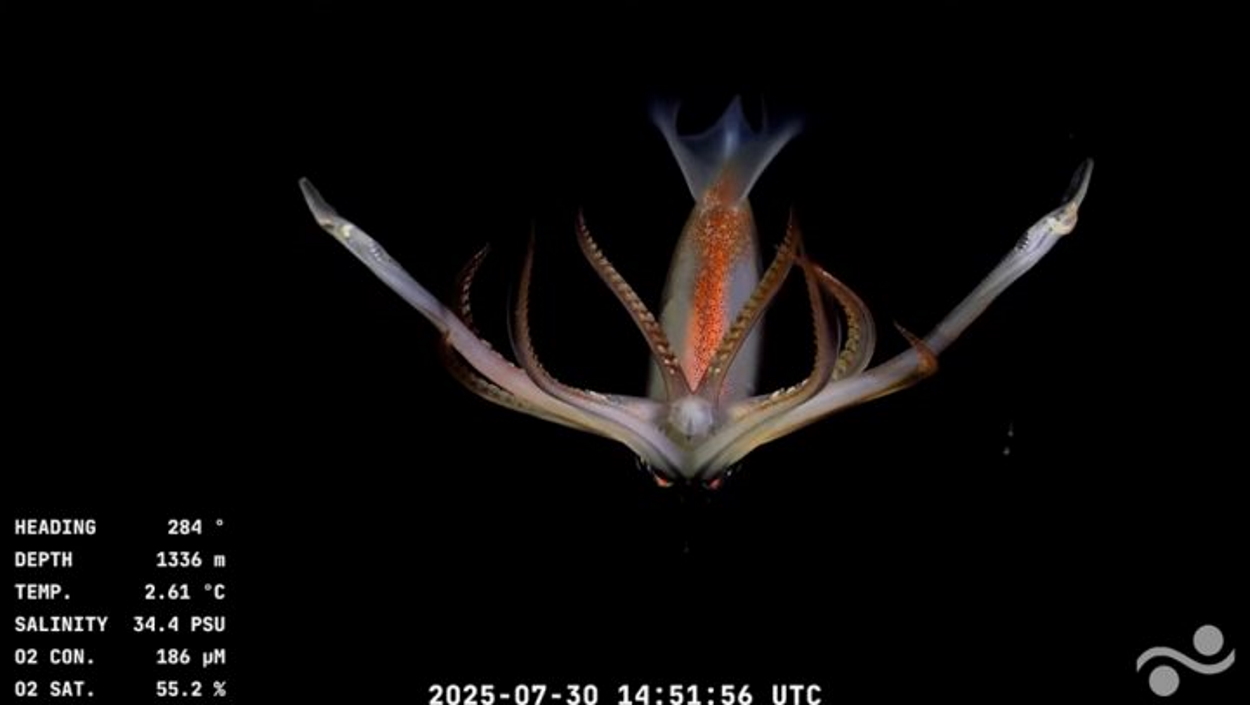
Follow the live broadcast from the Mar del Plata Submarine Canyon.
## Real-time science: live broadcast and open outreach
The live broadcast from the seabed transforms the expedition into a **public science communication tool**. “People can see the same as us, in real-time. That forces us to explain clearly and makes science something everyday,” says Lauretta.
Additionally, the team plans to generate **3D models of emblematic species**, produce **educational material for schools and museums**, and publish all data in **open repositories** such as **CONICET Digital, OBIS, and GenBank**.
## Scientific continuity and previous findings
This mission follows the campaigns **Continental Slope I, II, and III**, carried out with the **Puerto Deseado Oceanographic Vessel**, which allowed for the description of **dozens of new species** and the documentation of an **unexpected diversity** in cold-water corals, mollusks, echinoderms, crustaceans, deep-sea fish, and their parasites.
To watch the live broadcast, [click here](https://www.youtube.com/@SchmidtOcean).


