



A team of scientists from the New York University in Abu Dhabi developed a model of Artificial Intelligence (AI) capable of predicting solar wind speed up to four days in advance. This significantly surpasses the accuracy of current methods.
The study was published in the supplement series of The Astrophysical Journal, and represents a strategic advancement in critical infrastructure protection.
Solar Wind: Charged particles that alter the Earth’s atmosphere
Its impact can destabilize satellites, power grids, and navigation systems.
The solar wind is a constant flow of charged particles emitted by the Sun. When it intensifies, it can trigger geomagnetic storms that affect the Earth’s atmosphere, pull satellites out of orbit, damage electronic components, and interfere with power grids.
In 2022, a solar wind event caused the loss of 40 Starlink satellites. This highlighted the urgency to improve early warning systems.
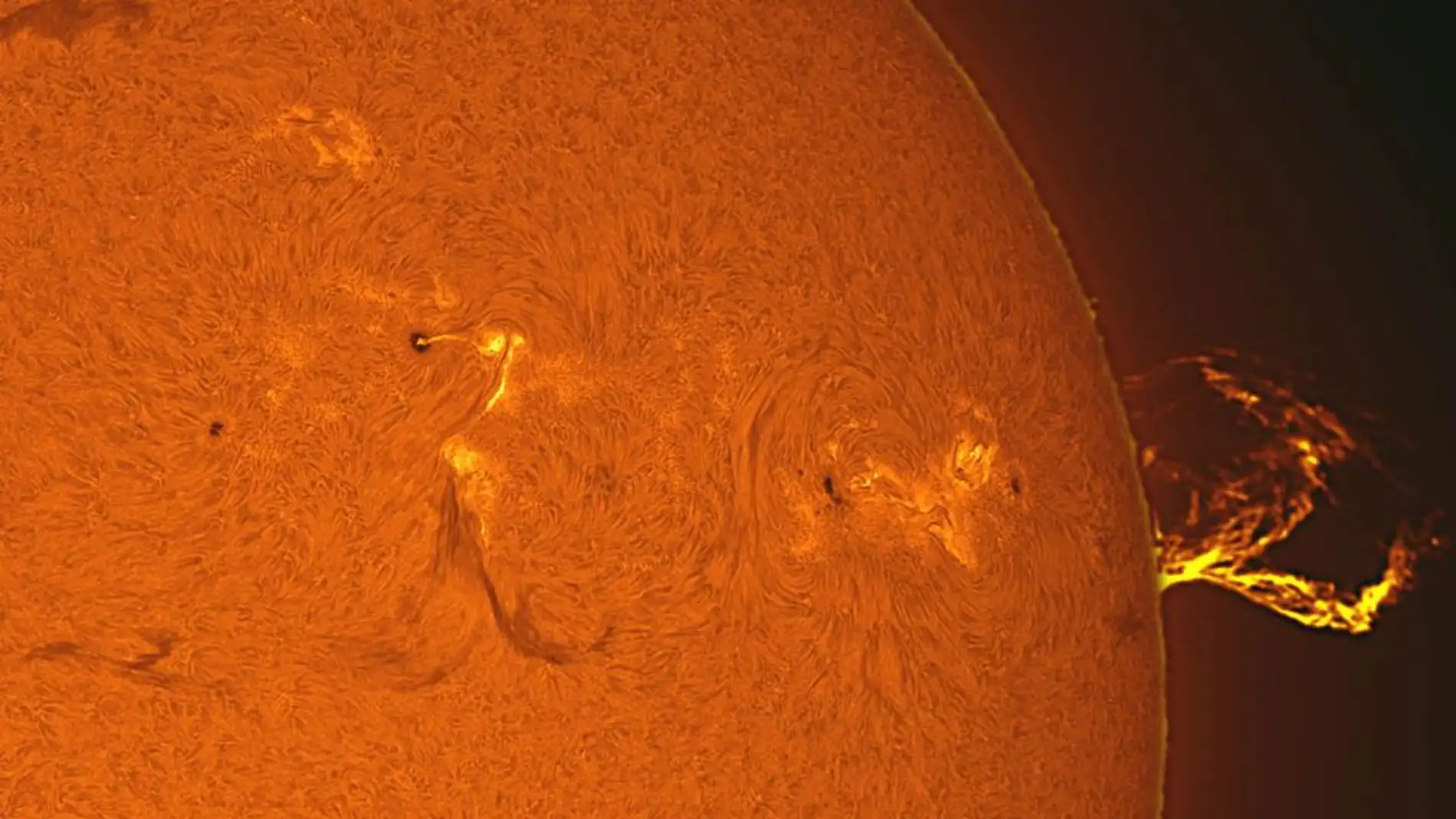
UV Image-based AI: 45% Improved Accuracy
The model analyzes solar patterns to anticipate variations in solar wind.
Unlike traditional language models, this AI system processes high-resolution ultraviolet (UV) images from the NASA Solar Dynamics Observatory (SDO), combined with historical records of solar wind.
The result: a 45% improvement in accuracy compared to current operational models, and a 20% improvement over other AI-based approaches.
“We can issue early alerts that help safeguard critical technology on Earth and in space,” noted Dattaraj Dhuri, a researcher at the Center for Space Science (CASS).
Types of Solar Wind and Factors Affecting its Speed
From coronal holes to magnetic variations, the Sun defines the behavior of solar plasma.
- Slow Wind: originates in regions with closed magnetic field lines, with speeds between 300 and 400 km/s
- Fast Wind: comes from coronal holes, colder and less dense areas of the solar corona, with speeds of 400 to 750 km/s or more
The temperature of the solar corona, magnetic activity, and planetary interactions influence the intensity and direction of the solar wind, which can exceed a million miles per hour.
Space Science and Technological Resilience
Anticipating solar phenomena is key to protecting modern life.
This advancement demonstrates how AI can tackle one of the most complex challenges in space science.
With more reliable forecasts, scientific and technical teams can strengthen the resilience of satellites, power grids, and navigation systems, minimizing the impact of space weather events.



