



The **imperial cormorant** (*Leucocarbo atriceps*), also known as the blue-eyed cormorant, is one of the most emblematic and key seabirds for the **environmental balance of the** **Patagonian coast**. Also, its presence is crucial to ensure the balance and health of the environment in the area.
That’s why it motivated the development of **different scientific projects to analyze the species**.
This bird is distributed in **around 60 colonies along the Patagonian coast**, with an estimated population of 55,000 breeding pairs, according to data from the **Administration of Marine Protected Areas**. Its presence, besides being fascinating for ecotourism, has a fundamental **scientific and environmental value**.
## A natural indicator of the environmental balance of the Patagonian coast
The imperial cormorant is **considered an indicator species**, as the state of its populations directly reflects the **health of the marine and coastal ecosystems** where it lives.
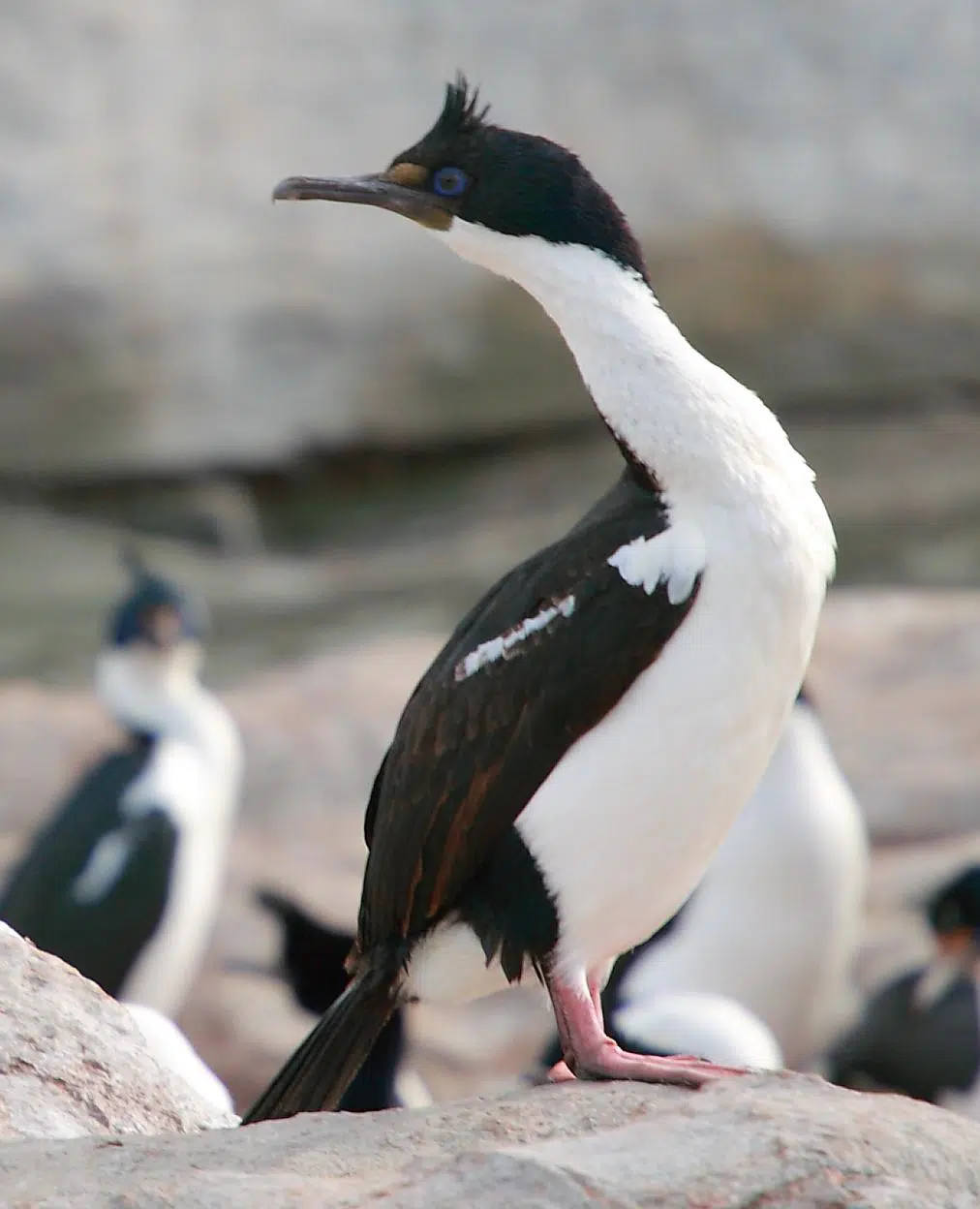
Its diet consists of **fish, crustaceans, and cephalopods**, which it catches during dives that can last up to 30 minutes underwater, one of the longest among diving birds.
Although **it is currently not classified as a threatened species** neither in Argentina nor globally, it faces increasing pressures. The loss of coastal habitats, **tourist and urban developments**, and human presence in sensitive areas pose risks to the stability of its colonies.
## Conservation of seabirds: Argentine science with continental impact
The growing interest in protecting the imperial cormorant led to the development of **various scientific projects** in Patagonia. One of the most prominent is led by **Magalí Olmedo Masat**, a fellow at the Center for the Study of Marine Systems (**CESIMAR-CONICET**).
Her proposal was recognized by the **American Ornithological Society (AOS)** as one of the most relevant in Latin America and the Caribbean.
Olmedo Masat’s research uses **satellite images to monitor** seabird colonies in Patagonia, with the aim of identifying and characterizing the breeding sites of the imperial cormorant.
This technological approach is **complemented by flights in light aircraft**, the use of drones, and field observations, allowing the validation and comparison of different data collection methods.
Thanks to this **combination of science and technology tools**, the team seeks to estimate more accurately the quantity and density of individuals. Also, to detect changes in territory use, something essential to anticipate threats and **plan conservation strategies**.
## The relevance for protected areas on the Atlantic coast
This work is crucial for spaces like the **Marine Coastal Interjurisdictional Park Southern Patagonia** in the province of **Chubut**. It is one of the sites where the marine biodiversity of southern Argentina is concentrated.
The information will strengthen the management of protected areas, detect population variations, and define evidence-based public policies.

Additionally, the study results will have a **broader impact on the protection of other coastal environments** in the South Atlantic, where human pressure and climate change threaten delicate natural balances.
It is worth noting that the international support received by Magalí Olmedo Masat highlights Argentina’s scientific capacity in environmental research and conservation.



