



Scientists from the CONICET have discovered one of the most complete and young species of the Megaraptoridae group of carnivorous dinosaurs in Chubut, as reported by noticiasambientales.com.
An interdisciplinary team led by Lucio Ibiricu, a researcher from CONICET at the Patagonian Institute of Geology and Paleontology (IPGP), presented the discovery of a new species of carnivorous dinosaur: Joaquinraptor casali.
This dinosaur belongs to the Megaraptoridae group, known for their large claws and predatory behavior. The discovery was published in the international journal Nature Communications.
## A top predator in the Late Cretaceous ecosystem
It measured over 7 meters, weighed a ton, and lived near the end of the dinosaur era.
The specimen was found in the Lago Colhué Huapi Formation in central-southern Chubut, where Comodoro Rivadavia and Sarmiento are located today.
According to Ibiricu, Joaquinraptor would have been at least 19 years old at the time of its death, and it is estimated to have been one of the last representatives of the Megaraptoridae group just before the mass extinction that occurred 66 million years ago.
“It was probably one of the top predators in the ecosystem,” says the researcher.
## An articulated skeleton and a key arm for the osteology of the group
The discovery includes unique pieces that allow comparison with other Megaraptoridae.
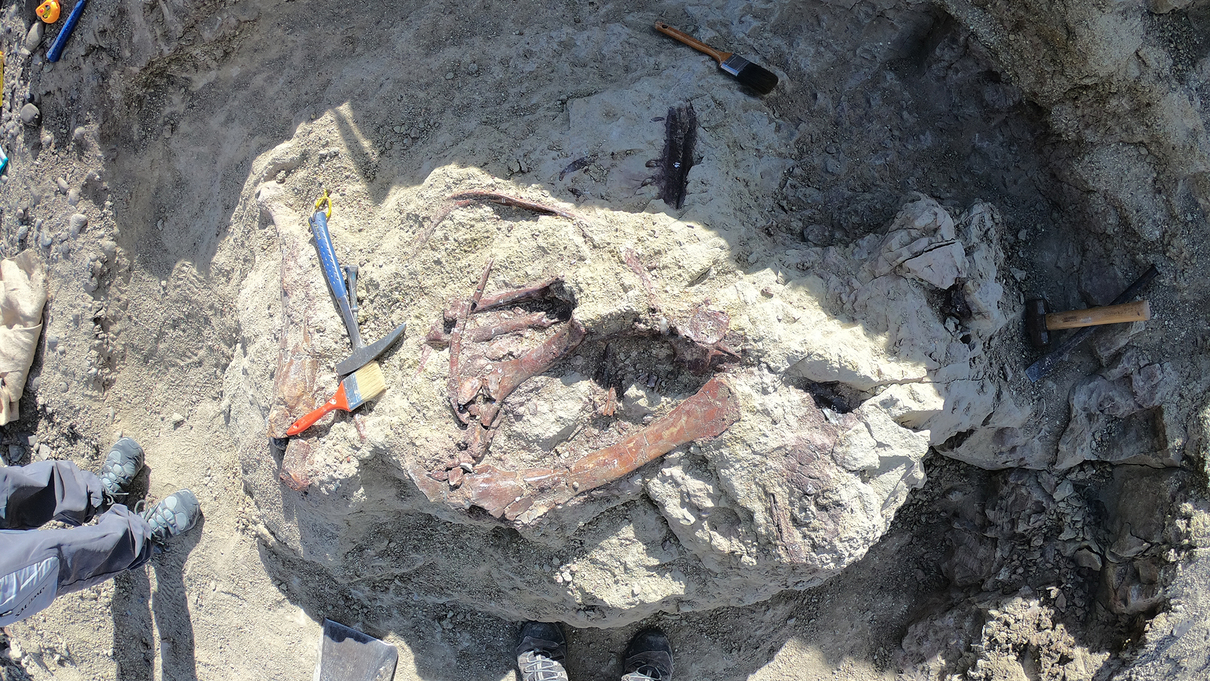
The remains were detected in 2019 and extracted in subsequent campaigns. The skeleton is partially articulated, making it one of the most complete in the group.
The detailed study of its anatomy, especially the articulated arm and maxilla, provides new osteological information and allows for a review of the phylogenetic relationships within the Megaraptoridae.
## Ecological interactions: a humerus between the jaws
The presence of a crocodilian bone suggests possible feeding habits.
During the excavation, a crocodilian humerus was found between the dinosaur’s jaws, suggesting that these terrestrial vertebrates could have been part of its diet, although other ecological interactions are not ruled out.
“This finding gives us clues about the possible food sources of Joaquinraptor and the group in general,” explains Ibiricu.
## A tribute in the name and a federal scientific collaboration
The name honors Joaquín, the author’s son, and Gabriel Casal, a reference in paleontology.
The name Joaquinraptor pays tribute to the author’s son, while Casali acknowledges Gabriel Casal, the director of the Dr. Rubén Martínez Vertebrate Paleontology Laboratory.
The study was conducted by researchers from CONICET, UNPSJB, Universidad Nacional de Río Negro, IIDEPyS-GSJ, and the Carnegie Museum of Natural History, establishing a national and international scientific network.



