



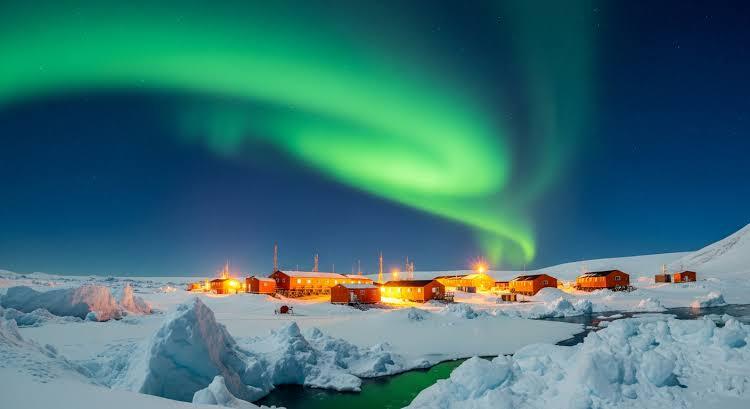
The National Meteorological Service (SMN) released images captured at the Belgrano II Base, showing the sky illuminated by southern lights.
These luminous greenish curtains moved across the horizon, offering a unique spectacle at one of the southernmost Argentine bases on the continent.
The extreme location of Belgrano II, with long periods of darkness during the austral winter, makes this site a privileged point for observing phenomena associated with solar activity.
How auroras are formed
Auroras originate when charged particles from the Sun are guided by the Earth’s magnetic field towards the polar regions. Upon entering the atmosphere, they interact with gases like oxygen and nitrogen, releasing energy in the form of light.
- Green: associated with oxygen in high layers.
- Red, violet, or blue: depend on the height and the gas involved.
When solar storms occur, the solar wind reaches the magnetosphere with greater energy, generating geomagnetic storms that intensify the brightness and extent of the auroras.
Scientific and climatic value
The SMN’s interest is not limited to visual beauty. The Argentine bases play a key role in atmospheric monitoring, recording variables such as temperature, wind, pressure, and humidity.
Observing southern lights allows the study of how solar activity impacts the Earth’s atmosphere and the so-called space weather, whose effects can alter:
- Communications.
- Satellite systems.
- Air and maritime navigation.
- Electrical grids.
Antarctica: natural laboratory
Argentine Antarctica is a privileged setting for climate and space science. The absence of light pollution and proximity to the South Pole make its bases strategic points for observing phenomena that connect the Sun, Earth’s magnetic field, and the atmosphere.
The video shared by the SMN combines two dimensions:
- Natural beauty: a unique postcard of the Antarctic sky.
- Scientific information: data on physical processes affecting the entire planet.
Importance for dissemination
The records of southern lights from Antarctica have special value for the Argentine population. As a phenomenon infrequent in mid-latitudes, the images allow the public to glimpse scenes occurring in remote areas, far from light pollution and urban centers.
Moreover, these observations reinforce the importance of Antarctic science as a tool to understand global phenomena. The interaction between the Sun and Earth not only creates visual spectacles but also influences the stability of technological systems we use daily.
The southern lights recorded from the Belgrano II Base are more than a visual spectacle: they represent an opportunity to better understand the interaction between the Sun and Earth and reinforce Antarctica’s role as a fundamental territory for scientific observation.



