



More than 14,000 fragments of space junk are orbiting Earth at speeds faster than a bullet. These are debris from rockets, decommissioned satellites, and detached pieces moving uncontrollably, endangering active missions and even the International Space Station (ISS), which must regularly adjust its trajectory to avoid collisions.
The accumulation of this debris is turning low Earth orbit into an increasingly dangerous environment. From small bolts to large structures, everything moves at over 17,500 miles per hour, greatly increasing the possibility of devastating impacts. Each new collision generates more fragments, feeding a cycle that is hard to control.
Faced with this scenario, the scientific community has warned about the urgency of finding alternatives to reduce the saturation in orbit. Without effective intervention, the expansion of the so-called “space junk” could hinder access to space and compromise the security of satellites that support essential systems on Earth, from communications to climate monitoring.
Confronting this challenge, a team from Tohoku University in Japan has developed a bidirectional ion engine capable of diverting debris without the need for physical contact. Their innovation promises to open a new path to address one of the most silent environmental crises of the technological era.
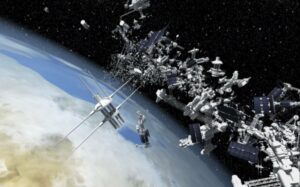
The bidirectional ion engine: contactless innovation
So far, many proposals to clean up the orbit have relied on nets, cables, or robotic arms trying to capture moving debris. However, these systems face the challenge of controlling objects that spin unpredictably. Any mistake could jeopardize the spacecraft responsible for the collection.
The Japanese engine introduces a different approach: projecting a plasma jet towards the fragment, gradually diverting it until it re-enters the atmosphere and disintegrates. Unlike traditional ion thrusters, this design features two opposing nozzles that neutralize the thrust, allowing the satellite to maintain its position while acting on the debris.
Moreover, the system operates with argon, an inert gas more abundant and cost-effective than xenon, making its implementation more sustainable and accessible. With this breakthrough, the orbital cleaning process could become safer, more efficient, and viable on a large scale.
Consequences of space junk
The increase of debris in orbit brings a series of ecological and technological consequences that go beyond space. One of the major risks is the so-called “Kessler syndrome,” a phenomenon where the collision of a fragment with a satellite generates more debris, which in turn causes new chain collisions. This scenario threatens to turn the low Earth orbit into an impassable belt of metallic remains.
The loss of active satellites would have a direct impact on daily life. Services such as weather forecasting, GPS navigation, environmental monitoring, and telecommunications rely on space infrastructure. A chain accident could disrupt these critical functions and delay scientific and technological projects crucial for the transition to more sustainable societies.
Furthermore, the danger of impacts forces the ISS and other satellites to perform evasive maneuvers that consume fuel and shorten their lifespan. With each adjustment, mission costs and complexity increase, reducing the efficiency of programs dedicated to environmental monitoring and the study of climate change.
 The innovative Japanese invention against space junk.
A future at stake
The proposal of the bidirectional ion engine represents a significant step towards solutions that reduce the impact of space junk. However, the challenge also requires strong international cooperation to establish prevention protocols, satellite reuse, and shared responsibility in the management of orbital debris.
Without joint action, space could become an unmanageable landfill, with consequences that would affect not only scientific missions but also the systems that sustain our daily lives on Earth. The future of exploration and global technology depends to a large extent on how we address this silent threat orbiting the planet.


