



On a remote hill in Guadalajara, Spain, the subsoil revealed a fossil set that remained hidden for 72 million years. Four titanosaur eggs, discovered at the Cretaceous site of Poyos, emerged in a surprising state of preservation.
The project, driven by the Government of Castilla-La Mancha, allowed the recovery of key pieces to reconstruct the European biological history. The eggs, with reddish tones and mineralized texture, were extracted using delicate techniques to avoid damage.
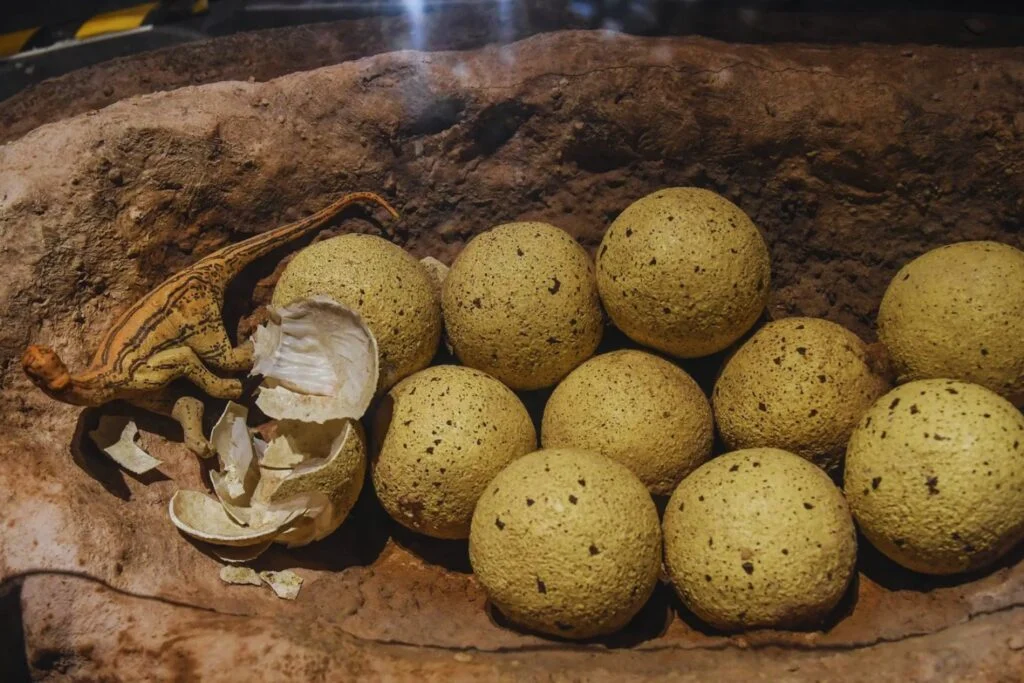
After their recovery, they became part of the permanent exhibition at the Paleontological Museum of Castilla-La Mancha (MUPA). There, they are presented as time capsules that preserve microscopic information of a vanished ecosystem.
Titanosaurs in the ancient Iberian landscape
Titanosaurs were the last great sauropods on the planet, giant herbivores that roamed the Iberian Peninsula at the end of the Cretaceous. The Poyos discovery gathers eggs with marked morphological differences in the same sedimentary level.
This unusual situation suggests the possible coexistence and simultaneous nesting of different species in the region. If confirmed, the site would become an international reference point for understanding the diversity of European sauropods.
Normally, discovered clutches belong to a single species, so this set raises unprecedented questions. The evidence invites reconsideration of how dinosaurs were distributed and reproduced in the final moments before their extinction.
Technology at the service of paleontology
The analysis of the shells was conducted by the UNED Evolutionary Biology Group, using advanced microscopy and mineralogy techniques. The results revealed an almost intact microstructure, an exceptional condition in fossils of such high antiquity.
This preservation allowed the differentiation of two types of eggs, which expands the evolutionary map of European titanosaurs. Among them, Fusioolithus baghensis was identified, already documented in other locations.
The second, Litosoolithus poyosi, corresponds to a new ootaxon characterized by thin shells, low porosity, and scattered ornamentation. The coexistence of both in the same stratum reinforces the simultaneous presence of various titanosaurs in the area.
A natural archive of the Cretaceous era
The geology of Poyos played an essential role in the conservation of the eggs. Fine sediments and low tectonic alteration favored a stable and long-lasting fossilization. This combination allowed the preservation of even fragile layers that are often lost over millions of years.
Researchers point out that this stability might have also protected original chemical traces. If confirmed, they would provide information about the biological composition of the shells and their environment. The discovery positions the site as a natural laboratory for future research on prehistoric life.

What fossils reveal about the past
Each fossilized egg functions as an environmental and biological record. Its thickness, porosity, and texture allow inference of data about temperature, humidity, and incubation methods.
In Poyos, the differences between the shells suggest diverse reproductive strategies among coexisting species. These fossils reinforce the theory that Europe acted as a refuge for the last dinosaurs of the continent.
Recent findings in Cuenca and the Pyrenees point to a greater presence of sauropods in the region than previously thought. The discoveries in Guadalajara add to this line, expanding the evolutionary panorama of the end of the Cretaceous.
The echo of a lost world
More than 70 million years after their formation, the eggs continue to provide key information about the Earth’s past. Their state of preservation allows the reconstruction of details of an ecosystem that disappeared but left persistent traces.
The exposed fossils not only represent vestiges but also the possibility of unraveling processes that shaped life in the region. As analyses progress, MUPA visitors can observe the eggs as fragments of a moment frozen in time.
They are testimonies of an era when giant herbivores dominated the Iberian landscape. Their discovery consolidates the importance of paleontological research as a tool to understand planetary history.
New keys to reconstruct ancient ecosystems
The study of fossilized eggs offers unique information about climates, soils, and environmental conditions of the past. These data allow understanding how prehistoric ecosystems responded to natural climate changes.
This provides valuable references for analyzing current transformations derived from the environmental crisis. In fact, research on ancient reproductive strategies helps develop comparative biological models.
These models allow identifying evolutionary patterns that still influence certain modern species. Understanding these links strengthens programs for conservation of vulnerable fauna today.
Findings like that of Poyos foster social interest in the natural sciences. Museums can offer new perspectives to bring the public closer to paleontology and the care of natural heritage. The dissemination of these discoveries promotes citizen participation in the preservation of the environment.



