



A team of Russian scientists confirmed a discovery in the Caspian Sea: they would have found a new island. This generated impact in the international community.
The formation is located approximately 30 km southwest of Maly Zhemchuzhny, an already known island.
Discovery in the Caspian Sea: how the new island emerged
The island emerged, according to the scientists, due to the lowering of the water level, making it visible only a few centimeters above the surface, with clearly perceptible sand ridges.
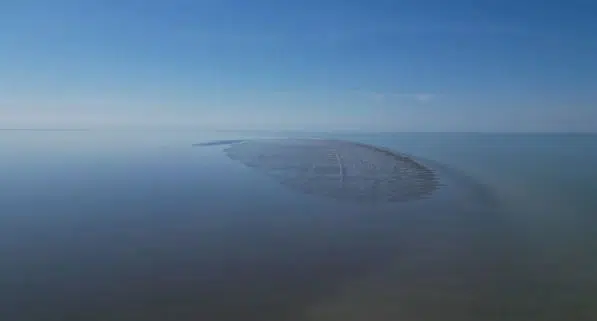 The discovered island.
A drone captured aerial images that show these ridges, although bad weather prevented the expedition from reaching the mainland.
The discovery was made by specialists from the Institute of Oceanology of the Russian Academy of Sciences. One of the researchers, Stepan Podolyako, explained that the phenomenon is not unique in the Caspian Sea, but it is unusual.
“These types of islands appear due to natural changes in the water level, something that has occurred over centuries, but that is now accelerated by human factors,” he said.
The Caspian Sea is the largest inland body of water on the planet, with an area of approximately 371,000 square kilometers. Throughout its history, it has experienced significant fluctuations in water level.
Between the 1930s and 1970s, there were marked decreases, followed by increases at the end of the 20th century. However, since 2010, the level has been decreasing again, a trend that has intensified in the last decade.
According to experts, this decrease in water level is closely related to climate change, the increasing evaporation due to rising temperatures, and alterations in the rivers that feed the Caspian Sea. Possible tectonic movements of the seabed are also mentioned as contributors to this process.
The first signs of the emergence of the island were captured by satellite images in November 2024, when a slow accumulation of sand emerging was observed. This prompted the deployment of a team of scientists to confirm the formation.
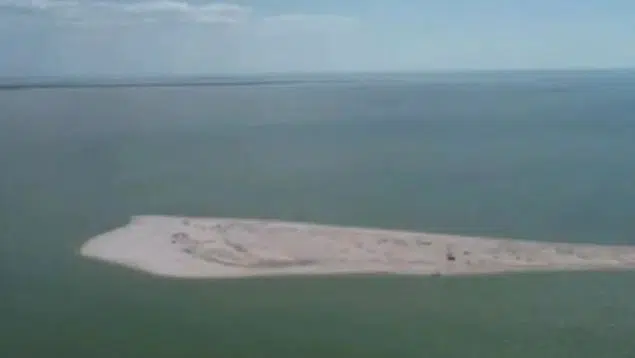 The discovery in the Caspian Sea.
Although it was not possible to reach the mainland this time, a new expedition is already being planned for the second half of 2025, with the aim of exploring the terrain and, if the structure remains stable, giving it an official name.
Additionally, it is expected that during the summer, the reduction in the flow of rivers that flow into the Caspian Sea will further lower the water level, which could expand the visible surface of this new island and facilitate landing.
What does this phenomenon indicate?
The discovery of this emerging island is a clear sign of the environmental impact affecting large ecosystems like the Caspian Sea.
Beyond scientific and geographic interest, it raises questions about the evolution of these environments in the face of climate variations. It is also an opportunity to better understand the effects of global warming and reflect on the urgent need to mitigate its consequences.



