



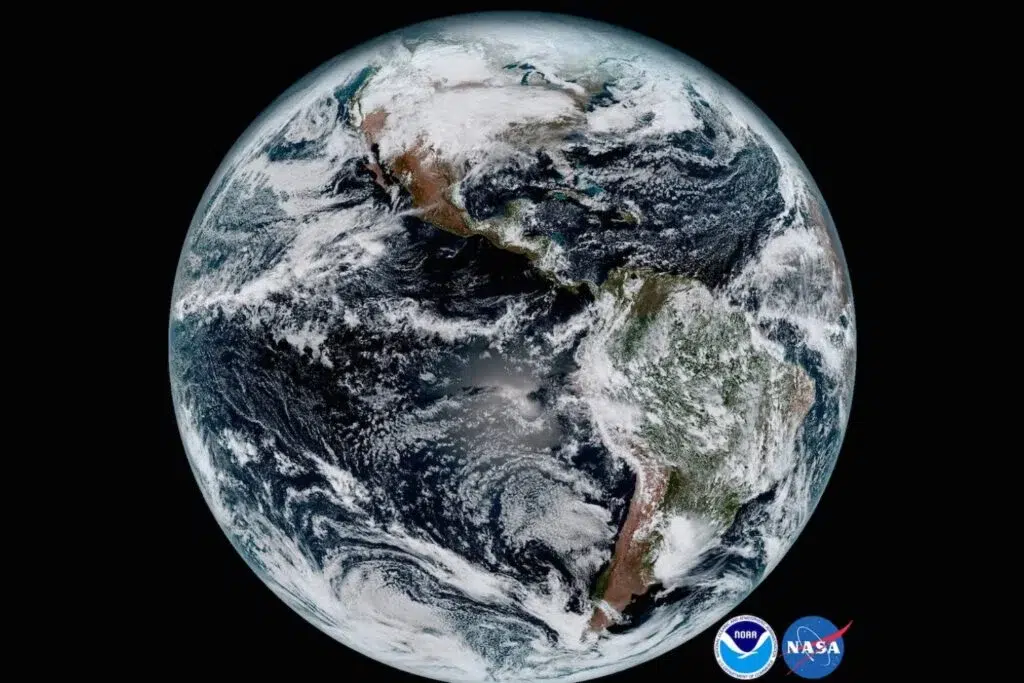
For millennia, Earth maintained an almost perfect balance of reflected light. However, although the continents and oceans are uneven, both hemispheres returned similar energy to space. Today, however, that harmony begins to fade on the planet.
In recent years, satellites have detected a persistent variation. Thus, the northern hemisphere reflects less solar radiation than the south. As a result, the planet absorbs energy unevenly.
This change is subtle but constant. Therefore, although it is not perceived at first glance, it alters the global climate system. In this way, the thermal stability that sustained the planet begins to weaken.
An uneven brightness that modifies the thermal balance
The satellite records of recent decades show a growing gap. Consequently, the northern hemisphere loses its ability to reflect sunlight. Meanwhile, the south maintains, and even increases, its reflectivity.
This phenomenon implies that the north absorbs more heat than it releases. Thus, small energy differences accumulate year after year and, over time, this excess accelerates regional warming.
Although the variation seems minimal, its impact is profound. For this reason, the energy imbalance begins to influence atmospheric circulation. In this way, the global climate enters a phase of forced readjustment.
Cleaner air, darker planet
Paradoxically, part of the problem arises from an environmental improvement. In recent decades, the northern hemisphere has reduced polluting aerosols. As a result, the air is cleaner but reflects less light.
Aerosols acted as microscopic mirrors. When they disappear, solar radiation reaches the surface with greater intensity. Thus, the health benefit brings an unexpected climate effect.
In contrast, the southern hemisphere experienced opposite episodes. Wildfires and major eruptions released particles into the atmosphere. Therefore, its ability to reflect energy increased temporarily.
The disappearing ice that darkens the planet
Another key factor is the accelerated loss of ice. In the Arctic, snow and sea ice recede year after year. As a result, light surfaces are replaced by dark ocean.
Snow reflects a large part of the solar radiation. However, when it melts, water absorbs almost all the energy. Thus, a vicious circle of warming and melting is activated.
This process intensifies summers in the north. Additionally, it alters winds and accelerates the melting of Greenland. In this way, the energy imbalance becomes increasingly profound.
Clouds unable to restore balance
For years it was believed that clouds would compensate for warming. The theory indicated that more heat would generate more reflective cloudiness. However, observations show that this is not happening.
Changes in tropical clouds are neutralized by polar ones. Therefore, the difference between hemispheres persists. Thus, Earth loses part of its natural damping mechanism.
Without this self-regulation, the climate system is more exposed. Consequently, small alterations produce greater effects. The planet becomes less stable in the face of changes.
Uneven warming that redefines the climate
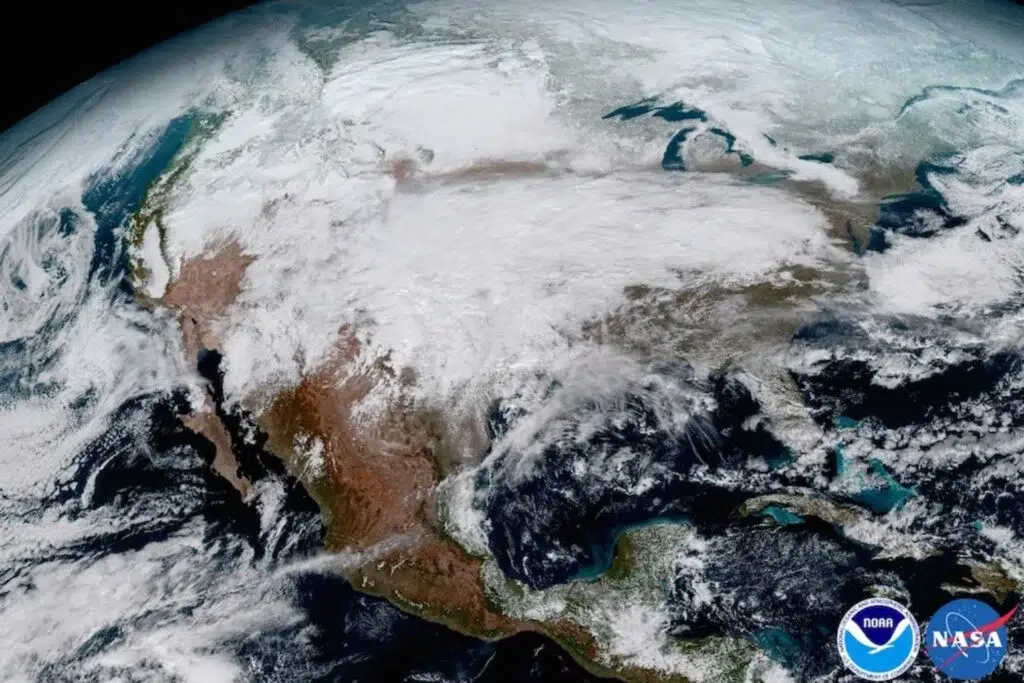
The impact is already reflected in temperature maps. The northern hemisphere is warming faster than the south. As a result, major atmospheric patterns are modified.
The band of tropical rains begins to shift. If the trend continues, southern regions will suffer droughts or extreme rains. Meanwhile, the north will face more intense storms.
Thus, a brightness difference detected from space could end up redrawing the planet’s climate map. The change, although gradual, would be profound and lasting.
How this imbalance affects the planet’s functioning
The energy balance regulates life on Earth. When it is altered, the oceans, atmosphere, and ecosystems react. Therefore, the uneven brightness impacts the entire planetary system.
The excess heat modifies ocean currents and global winds. Additionally, it influences the distribution of rainfall and temperatures. Thus, agricultural cycles, water resources, and biodiversity are altered.
If the imbalance intensifies, climate stability weakens. Consequently, extreme events become more frequent. In this way, the planet loses the harmony that allowed its balance for millions of years.
A reflection of the human footprint
Earth no longer shines as it used to. This change is not a scientific curiosity but a clear signal. Human activities are modifying the global energy balance.
The cleaning of the air, the melting and the fires interact. Together, they alter a system that took geological eras to form. Now, that balance is transforming in just a few decades.
Thus, the planet returns a disturbing reflection to us. The loss of symmetry reveals our accumulated influence. And, for now, it is not clear how to recover the lost brightness.


