



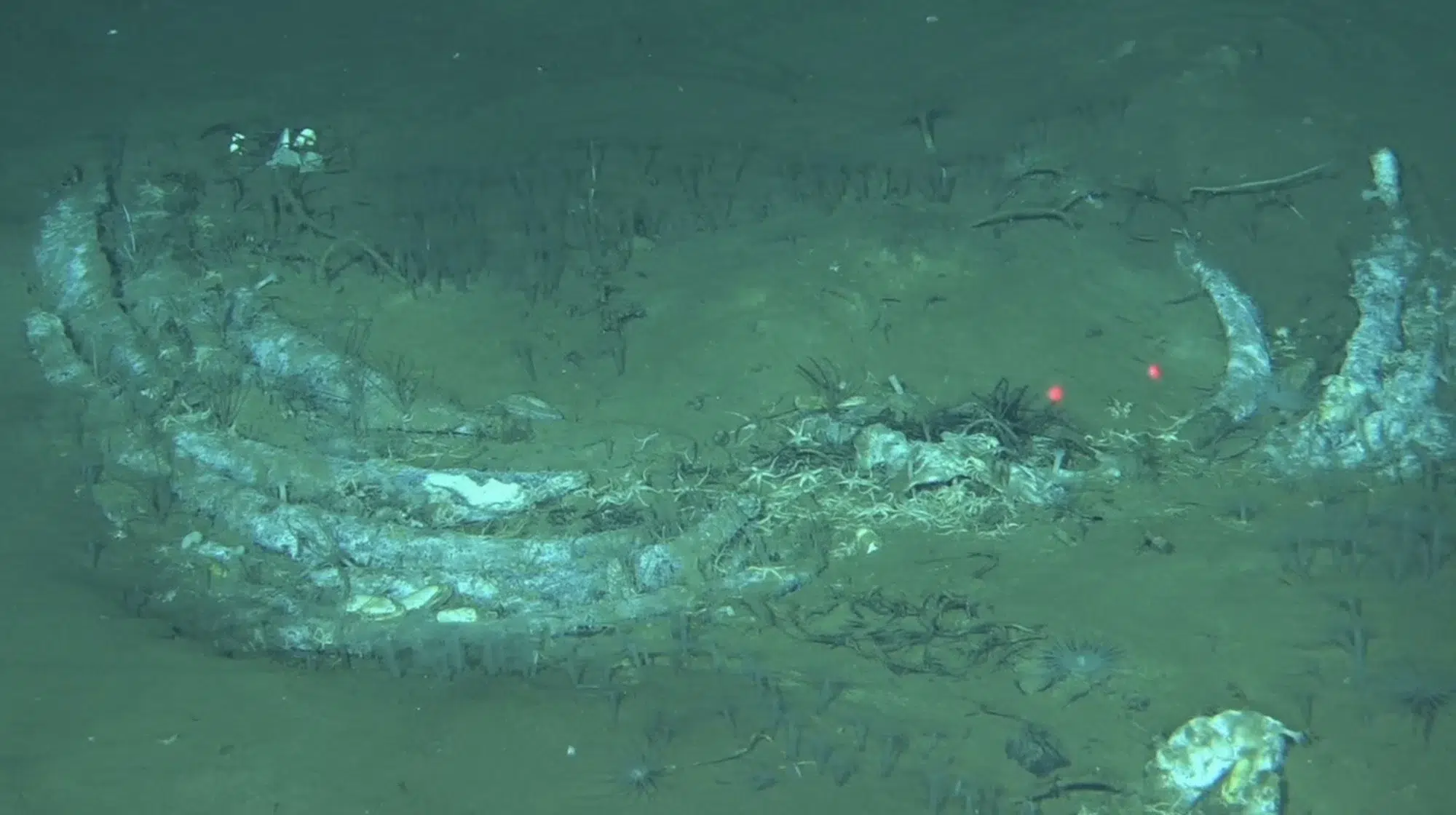
An international team of scientists led by the Chinese Academy of Sciences discovered a “whale cemetery” in the Diamantina Zone of the Indian Ocean that stretches over 1,200 kilometers of seabed, between 4,600 and 7,000 meters deep.
The study, published in the journal Nature, identified 476 whale fossils and five modern communities associated with carcasses, making this location the largest and deepest known whale necropolis to date.
“Whale Fall” Ecosystems
When a whale dies in the open sea, its body can sink thousands of meters to the ocean floor. There it transforms into an oasis of life in an environment where food is scarce. These ecosystems, known as whale falls, sustain for years or decades:
- Scavenger fish.
- Crustaceans.
- Specialized bone-boring worms.
- Mollusks that depend on bacteria for energy.
In the Diamantina Zone, modern remains were inhabited by communities dominated by ophiuroids (relatives of starfish), boring worms, and symbiotic mollusks.
A History of Millions of Years
Dating indicates that the deposits have been forming for at least 5.3 million years, making this region an exceptional fossil archive. Scientists found both current and extinct species of beaked whales, known for making some of the deepest dives among marine mammals.
The density of remains reaches 759.5 individuals per square kilometer, a figure never before recorded in similar studies.
Scientific Importance
Until now, knowledge about whale falls came from isolated observations in different oceans. This finding changes the landscape because:
- It represents the first such extensive and ancient concentration documented.
- It allows for the reconstruction of the evolutionary history of cetaceans on a geological scale.
- It suggests that other sectors of the deep ocean may preserve similar yet unknown records.
A Fossil Archive of the Deep Ocean
The sediments and bones accumulated in the Diamantina Zone constitute a natural archive that reveals how oceans have functioned as cemeteries and sources of life for millions of years. This finding opens new lines of research on:
- The evolution of cetaceans.
- The dynamics of deep marine ecosystems.
- The impact of biological processes on ocean chemistry.
The discovery of the underwater whale cemetery in the Indian Ocean is a milestone for marine science.
It not only documents the largest known cetacean necropolis but also offers a unique window into understanding life and death in the deep ocean, where each carcass becomes a driver of biodiversity and a fossil record of evolutionary history.



