



In the Philippines, a veterinary team led by Nielsen Donato, a specialist in exotic wildlife, managed to save the shell of a four-year-old African sulcata tortoise that had been run over twice. The animal arrived with a severely fractured shell and exposed soft tissue, at risk of dying from shock, infection, or dehydration.
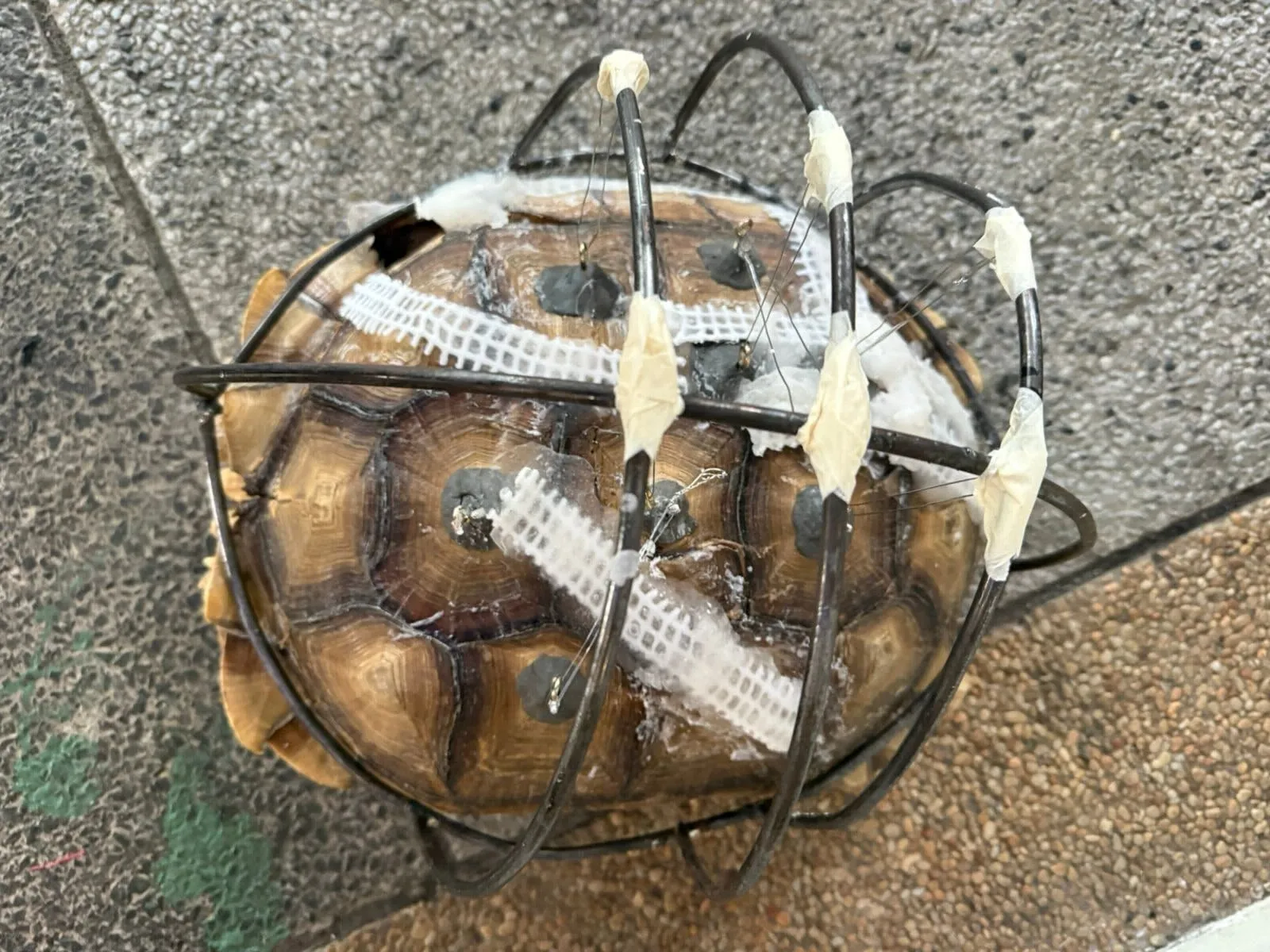
The solution was surprising: Donato designed an external structure of cables and metal framework that applied progressive tension on the fractured plates, allowing the cracks to align and the shell to regain its natural shape.
First Steps of the Rescue
When the tortoise arrived at the veterinary center, Donato was not physically present but coordinated remotely:
- Kept the exposed areas moist with saline solution.
- Stabilized fractures with inverted screws, epoxy putty, and elastic bands.
- Fed the animal through a tube and monitored its hydration.
- Administered antibiotics and painkillers.
- Avoided larval infestations, a frequent risk in open wounds.
Shell Reconstruction
The real challenge was repositioning the sunken plates without causing further damage. The cable structure allowed controlled pressure to be applied, aligning the pieces. Finally, the fractures were sealed with dental acrylic, a resistant and adaptable material. Weeks later, the tortoise regained mobility and began feeding normally.
Conservation Medicine with Limited Resources
This case reflects a common reality in Southeast Asian, Latin American, or African countries: veterinarians work with limited resources, without medical 3D printers or advanced laboratories, but with creativity and commitment, they manage to save lives.
Meanwhile, universities in the United States and Europe are experimenting with:
- 3D printed splints.
- Biodegradable biomaterials.
- Special resins adaptable to shell growth.
- Digital scanning for personalized bone reconstructions in reptiles and birds.
The Problem of Road Accidents
Road accidents are one of the main causes of mortality in terrestrial reptiles: tortoises, snakes, amphibians, and small mammals. Their slowness and tendency to remain still make them particularly vulnerable in urbanized environments.
Therefore, more and more cities are incorporating:
- Wildlife crossings.
- Specific fencing on roads.
- Signage in critical areas to reduce accidents.
Countries like Canada, the Netherlands, and Australia have been developing infrastructures adapted to amphibians and reptiles for years, showing that conservation can also occur in urban spaces.
The story of this sulcata tortoise and its shell demonstrates that conservation does not always require large laboratories: sometimes it only takes ingenuity, commitment, and creativity.
The cable structure designed in the Philippines is an example of how veterinary medicine can evolve with simple yet effective solutions, offering hope for wildlife affected by human activity.


