



An unprecedented discovery has just expanded knowledge about the biodiversity of the Argentine seabed. It occurred during the scientific mission “Continental Slope IV”, carried out by CONICET and INIDEP, in collaboration with the Schmidt Ocean Institute, which fascinated the country.
For the first time in national waters, they documented the presence of a specimen of the enigmatic “Dumbo” octopus, from the Grimpoteuthis genus.
Exploration of the Argentine seabed and a unique discovery
The expedition took place in the submarine canyon of Mar del Plata, one of the least explored abyssal ecosystems of the Argentine shelf.
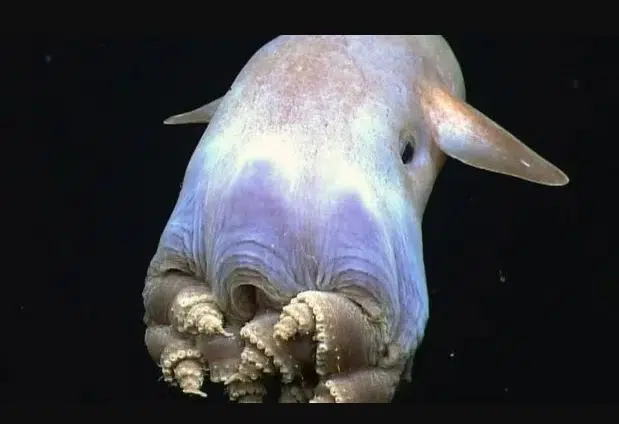
Using the underwater robot ROV SuBastian, the team managed to capture unprecedented images of the cephalopod swimming at 3781 meters depth. It is in an extreme environment where sunlight does not reach, the pressure is very high, and temperatures barely exceed 2°C.
“It was an absolutely extraordinary observation. It is the first time that an individual of this type has been documented in Argentine waters, and it has a pink coloration that is very rare in the literature,” said biologist Santiago Krapovickas, the project’s lead researcher.
What is the “Dumbo” octopus?
The “Dumbo” octopus belongs to the Grimpoteuthis genus and gets its name from the fins that protrude on the sides of its head, similar to the ears of the famous animated character. They are also known as “umbrella” octopuses due to the membrane that connects their arms.
Among their most outstanding characteristics are:
-
They lack an ink sac, so they rely on camouflage and stealthy movements to protect themselves from predators.
-
Their blood is copper-rich (hemocyanin), giving them a bluish tone and enabling efficient oxygen transport in extremely cold conditions and low oxygen concentration.
-
They feed on small mollusks, worms, and crustaceans, consuming them whole since they do not have a rigid beak like other cephalopods.
A key contribution to the conservation of the Argentine sea
This discovery adds to the recent impact of finding the starfish of the Hippasteria genus, also recorded in the area during the same mission. Both sightings reinforce the importance of continuing to explore the depths of the Argentine abyssal ecosystem, a territory where there are still multiple species unknown to science.
The presence of the “Dumbo” octopus in the Argentine Sea not only represents a scientific milestone but also confirms the hidden richness in the deep oceans and the need to protect these unique habitats against the advance of industrial fishing and climate change.



