



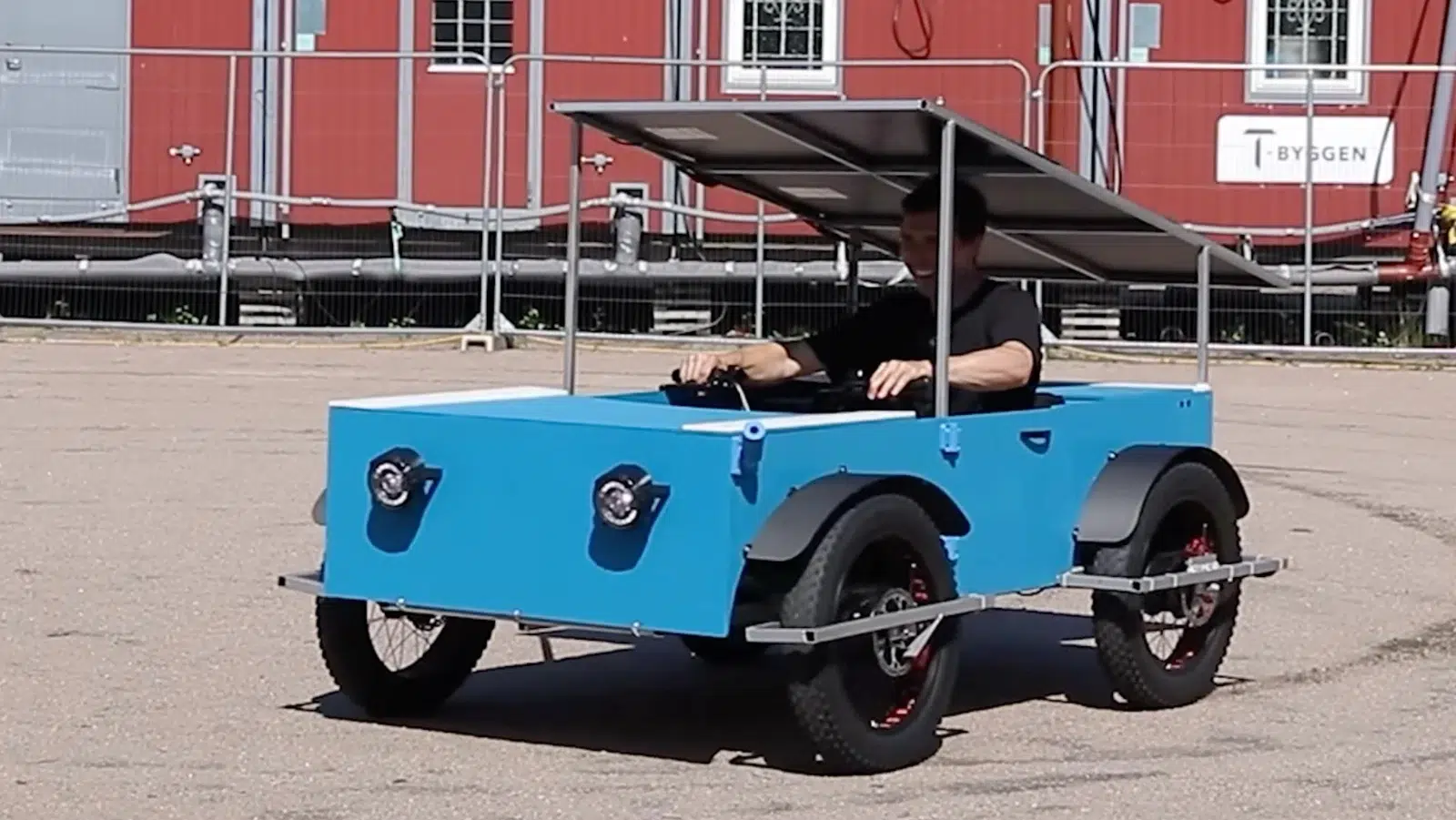
The Swedish YouTuber Simon Sörensen surprised his community by building an ultra-light solar car using parts from electric bicycles. The prototype reaches a maximum speed of 48 km/h and a range of up to 100 km, combining solar energy and battery.
His idea is based on a simple principle: reusing existing technology. Motors, batteries, and e-bike controllers are already optimized and available, allowing the creation of a functional vehicle without the need to reinvent components.
Technical Features
- Steel tubular chassis as a structural base.
- Two integrated electric bicycles, each with a 1,000 W hub motor.
- Configurable traction: front, rear, or all-wheel drive, improving stability on slopes and uneven terrain.
- Steering with Ackermann geometry, optimizing wheel turning in curves.
- Three lightweight solar panels on top, capable of generating 300 W.
- 48-volt battery, allowing the combination of direct driving with solar energy and battery backup.
Performance
Under favorable conditions, the vehicle can travel up to 32 km solely on solar energy. Adding the battery, the total range is around 50 km, and on sunny days it can reach nearly 100 km.
The maximum speed of 48 km/h makes it a viable alternative for urban and peri-urban travel, challenging the prejudice that solar vehicles are slow or merely experimental.
A Change of Focus
The project poses a reflection: not all vehicles need to be large and powerful. For everyday journeys —going to work, shopping, moving around rural areas— a lightweight and efficient car may be sufficient.
This type of development opens the door to:
- Ultra-light electric vehicles (category L in Europe), hybrids between bicycle and car.
- Decentralized production, with more room for repair, customization, and local adaptation.
- Resource optimization, reducing consumption and emissions.
Future of Solar Mobility
Advancements in more efficient batteries and lighter solar panels could significantly improve the performance of these systems in the coming years. It is not about an immediate revolution, but a constant evolution towards simpler and more sustainable mobility.
Simon Sörensen’s homemade solar car demonstrates that innovation does not always depend on large corporations. With creativity and the reuse of existing technologies, it is possible to design practical solutions that align with available resources and real mobility needs.



