



The National Scientific and Technical Research Council (Conicet) presented Casa CONICET, a digital platform that articulates science, technology, and society around sustainable construction.
The space offers innovative tools to respond to housing emergencies, improve permanent housing, and promote resilient habitat models in the face of climate change.
Catalog of sustainable construction solutions
From emergency sanitary modules to prefabricated systems in wood and lightweight earth.
The platform brings together construction systems designed by researchers, designed for different contexts.
It includes lightweight structural panels, solutions with biomaterials, and proposals that prioritize thermal and acoustic efficiency, with low environmental impact and accessible costs.
Recycled materials and biomaterials: applied circular economy
PET blocks, rubber tiles, and insulation boards with discarded polystyrene.
Casa CONICET incorporates innovative materials made from recycled and organic inputs, which improve housing comfort and reduce the ecological footprint.
These alternatives promote waste reuse, strengthen the circular economy, and democratize access to sustainable technologies.
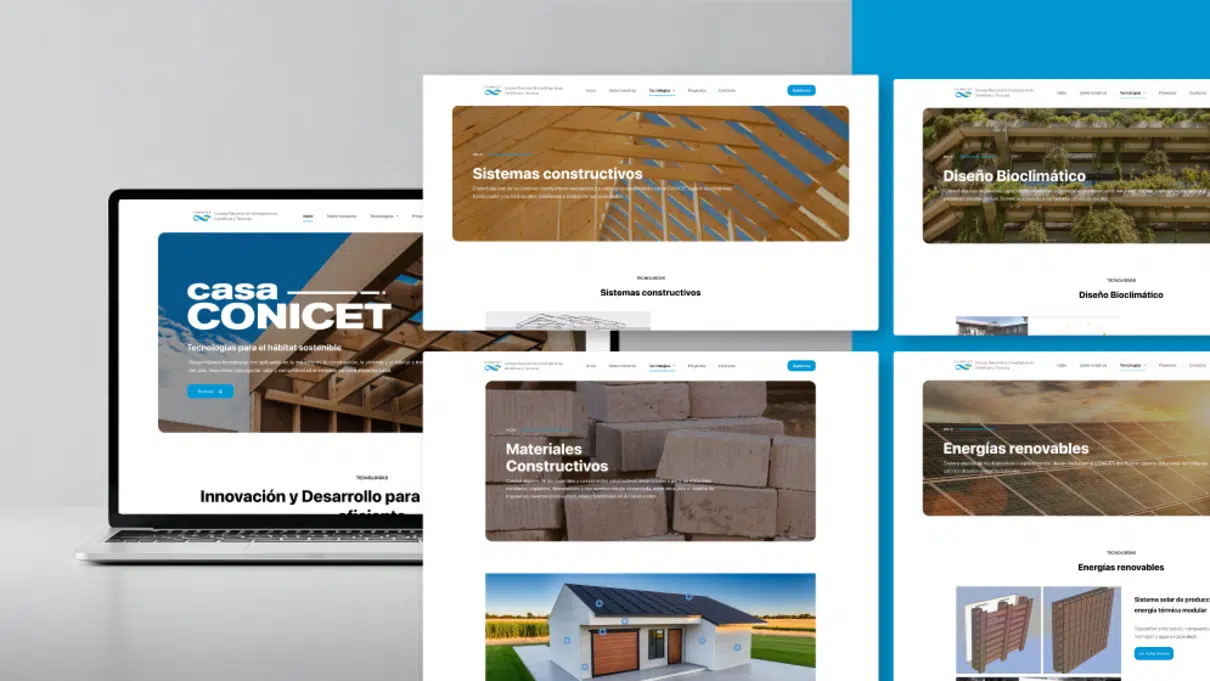 Casa CONICET: Technologies for Sustainable Habitat.
Bioclimatic design and energy efficiency
Simulations, technical advice, and proposals adapted to local climates.
The bioclimatic design section offers tools to optimize the use of natural resources, improve energy efficiency, and adapt architecture to the climatic conditions of each region.
It includes green facades, thermal envelopes, and analysis for new constructions or renovations.
Renewable energies for the habitat of the future
Modular solar systems, water heaters, and passive thermal storage devices.
The renewable energy area presents Conicet developments that address current energy challenges, with technical data sheets and regional adaptation criteria.
These solutions allow reducing energy consumption, improving comfort, and promoting the energy autonomy of homes.
Territorial projects and socio-productive articulation
Technologies applied in communities, cooperatives, and regional institutions.
Casa CONICET shows how science transforms into concrete solutions in the territory.
Experiences of construction with local wood, bioclimatic housing, and community recycling models stand out, developed in partnership with cooperatives and local actors.
Benefits of sustainable housing
Environmental impact, economic savings, health, and climate resilience.
- Less resource consumption and emissions reduction
- Use of rainwater and local materials
- Savings on bills and greater construction durability
- Thermal comfort, indoor health, and connection with nature
- Adaptation to climate change and promotion of a sustainable future
To explore the Casa CONICET Platform, click HERE.



