



A group of entrepreneurs from General Villegas started a tulip plantation with the aim of diversifying local production and stimulating projects related to floriculture and rural tourism.
This first step seeks to take advantage of the agroclimatic conditions of the region and promote new productive opportunities in the Buenos Aires province.
The initiative began with a pilot tulip plantation, designed not only as a decorative production, but as the beginning of a project with economic, social, and touristic potential.
Tulip plantation to innovate and diversify: how the project works
Inspired by successful experiences in the south of the country, such as Trevelin in Chubut or Huinganco in Neuquén, Romina Dominguez Carvalho and Daniel Colombo seek to replicate the model and adapt it to the productive profile of Villegas.
The first bulbs arrived at the right time, taking advantage of the low winter temperatures that are ideal for these flowers to thrive.
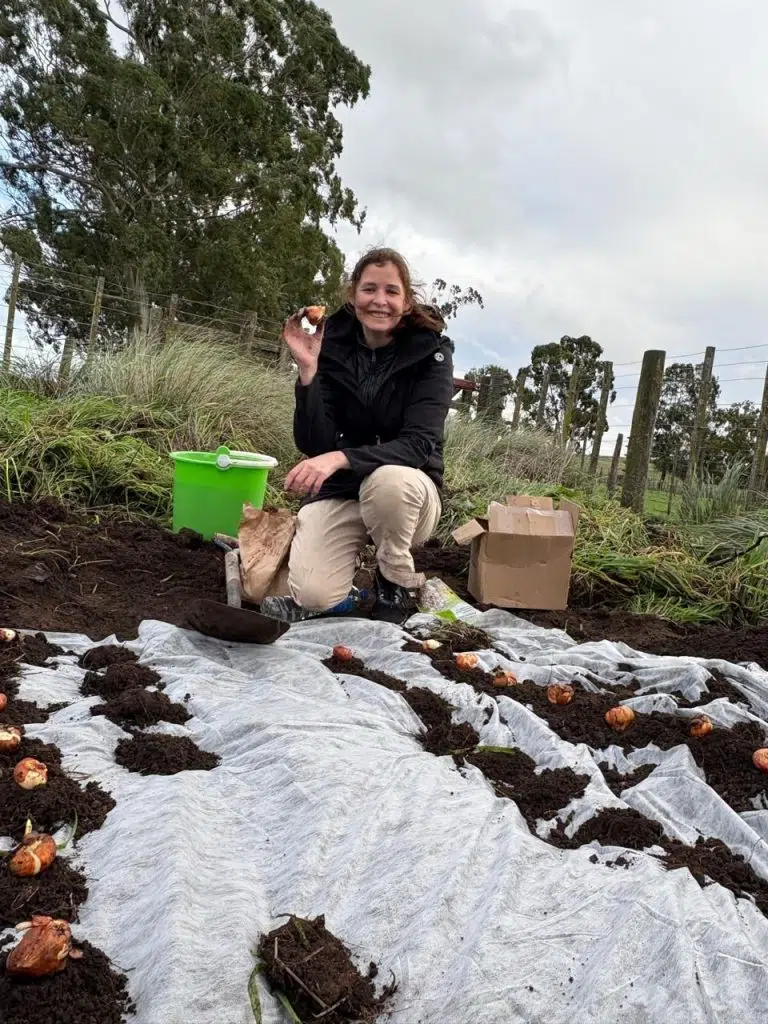
The intention is not only to commercialize tulips as cut flowers, but also to create a tourist attraction. Thus, the goal is to create a rural circuit where visitors can explore flowered fields, learn about the cultivation process, and buy directly from local producers.
The plantation is conceived as a trial, but there is a bigger vision behind it: to diversify the productive matrix of the district, offer a sustainable alternative, and add value to rural work.
This type of venture also has a direct impact on the community. It promotes local employment and training in areas such as floriculture and nursery management.
From the field to the experience
Another noteworthy aspect of this project is that it does not stop at production. It also focuses on the experiential aspect.
The idea is for the tulip field not only to produce flowers, but also emotions. To become a place to visit, photograph, and enjoy, as is the case in other regions where floral tourism is already established.
With the momentum of this first step, the entrepreneurs are already thinking about adding new varieties, developing their own nurseries, and working together with institutions such as INTA or the National University of the Northwest (UNNOBA). The goal is always to scale the project sustainably.


