



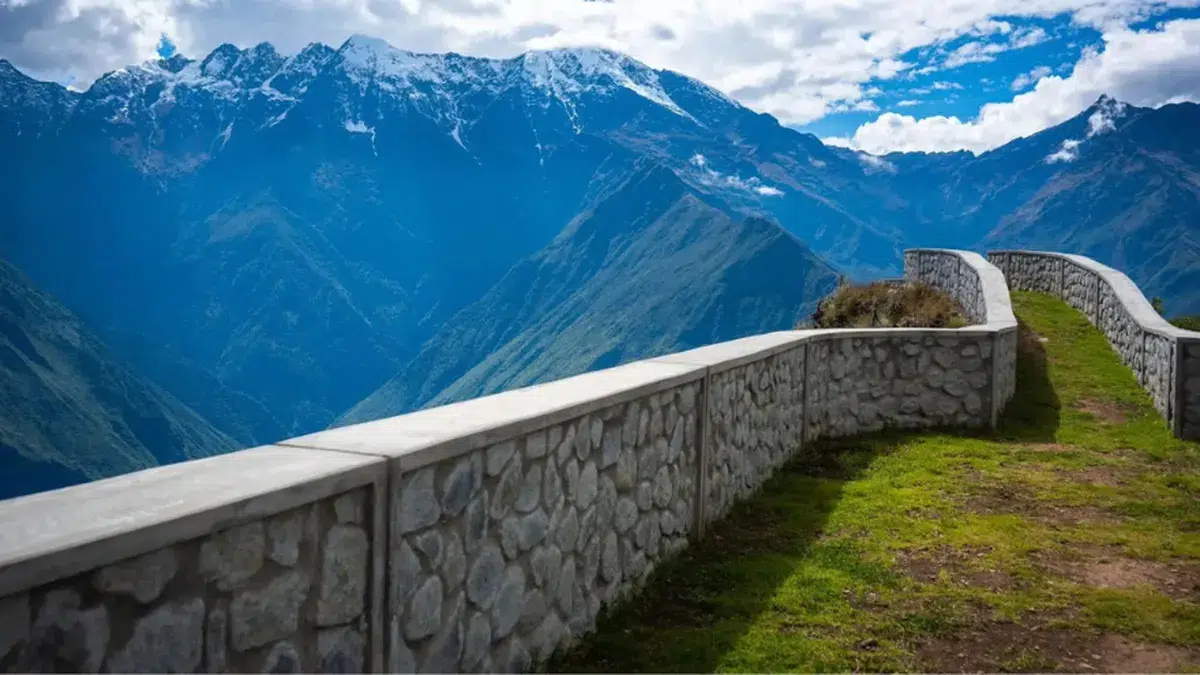
The lookout of Huayhuacalle, popularly dubbed the “Andean Chinese Wall,” has become one of Peru’s most striking attractions.
Located in the district of San Pedro de Cachora, province of Abancay, it offers unique views of the Apurímac Canyon, considered one of the deepest in the world with a depth of 4691 meters.
Its infrastructure, inspired by the famous Asian wall, merges contemporary architecture with the imposing surroundings of the Andes Mountain Range, attracting between 150 and 200 daily visitors.
Landscapes and emblematic fauna
From the lookout, you can observe:
- The course of the Apurímac River, which stretches for 700 km.
- The snow-capped Padreyoc.
- The archaeological complex of Choquequirao, known as the “sacred sister of Machu Picchu.”
- Sightings of Andean condors, thanks to the presence of nests in the area.
This space is part of the Apurímac Canyon Tourist Circuit, which seeks to enhance the region as a destination for adventure and nature.
Economic and cultural impact
Local authorities highlight that the project boosts the economy and generates employment for families linked to tourism. Additionally, it is projected as a strategic complement to the future Choquequirao Cable Car, which will facilitate access to one of South America’s most important archaeological sites.
The initiative is part of a set of nine planned lookouts, including the upcoming Incarracay Lookout, and reinforces regional identity with cultural elements such as the representation of the condor.
Sustainable tourism
The project, funded by the Regional Government of Apurímac, aims to promote sustainable tourism and strengthen the local economy. Specialists estimate that the region could receive more than one million visitors a year, which would open alternative routes to Choquequirao and consolidate Apurímac as an international tourist hub.
Beyond recreation, the lookout is an example of harmony between contemporary architecture and historical tradition, promoting the preservation of the natural and archaeological environment.
International comparison: the “Chinese Wall of Spain”
The concept of a natural wall also exists in Europe. In the Montsec mountain range, Ribagorza region (Spain), are the Roques de la Villa, known as the “Great Chinese Wall of Spain.” This limestone geological formation emerged in the Cretaceous and served as a natural defense in the Middle Ages.
At its feet lie the remains of the uninhabited village of Finestres, abandoned in 1960 after the construction of a reservoir. There, the Romanesque hermitage of San Vicente, from the 11th century, crowns the rocky ensemble.
Access is complex: it requires traveling a 10 km dirt track from Estopiñán del Castillo, although it can also be viewed through boat excursions on the Canelles reservoir.
The “Andean Chinese Wall” is establishing itself as a new tourist icon of Peru, capable of combining spectacular landscapes, cultural heritage, and sustainable development.
Like its Spanish counterpart, it represents the union between nature, history, and responsible tourism, offering unique experiences for national and international travelers.


