



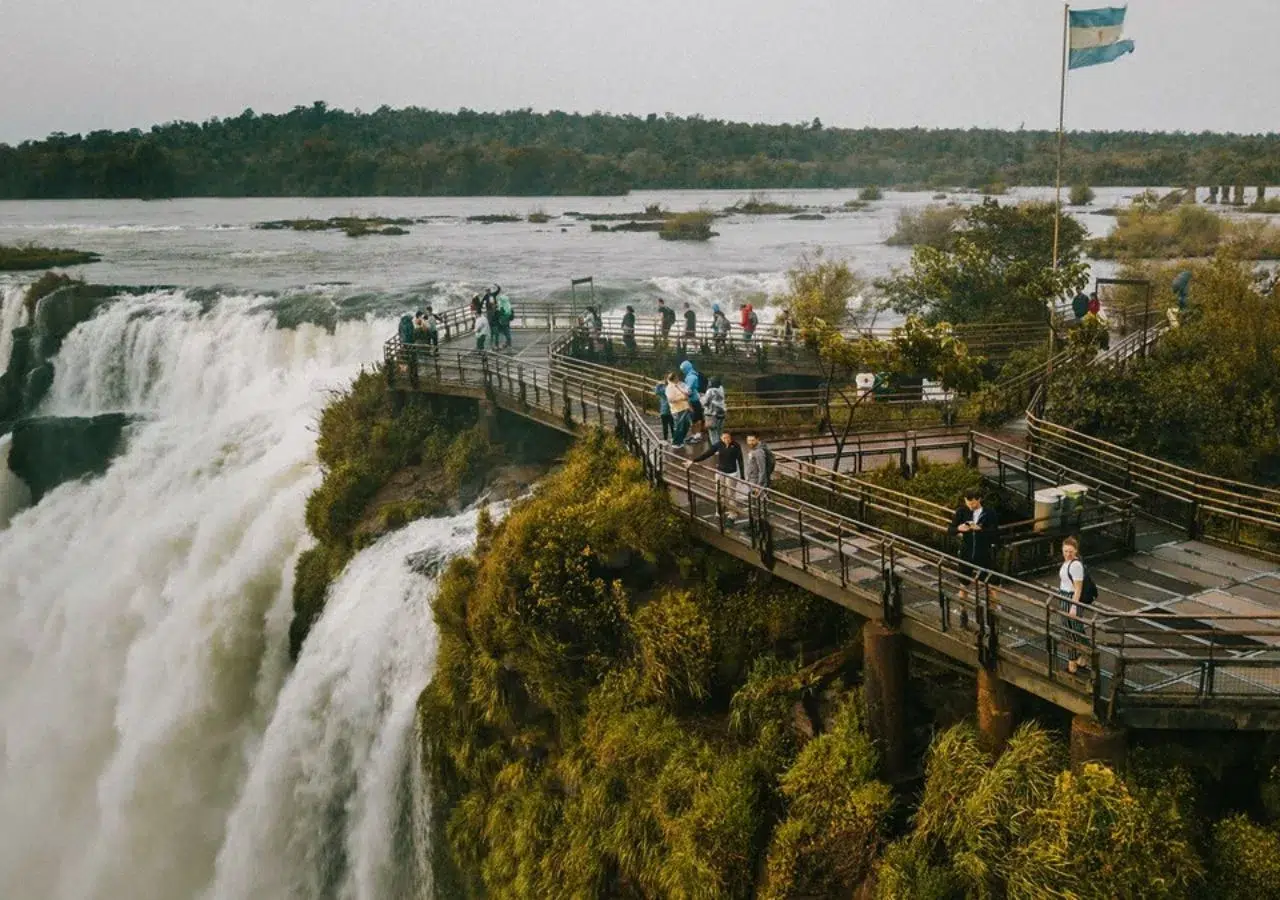
The Devil’s Throat is one of the most well-known tourist attractions in Misiones, located in the majestic Iguazu Falls. For this reason, hundreds of visitors to the Iguazu National Park will feel relieved to know that the circuit has reopened its walkways.
The reopening took place after the necessary final inspections were completed to ensure the structural integrity of the walkways. The official communication emphasizes that “safety conditions are guaranteed” for the public.
Days ago, Iguazu National Park, along with the service concessionaire Iguazu Argentina (IASA), announced the closure of this circuit due to the heavy rains and the increase in the flow of the Iguazu River.
It was a temporary and preventive closure, while monitoring of weather conditions was carried out, as well as the water flow, to enable the route as soon as possible.
A journey through nature in its full splendor
The Devil’s Throat features jumps over 150 meters long and a drop of over 80 meters high, equivalent to a 30-story building. Its drop converges in a horseshoe shape and has an average flow of 1500 cubic meters per second, enough to fill 36 Olympic pools in just one minute.
However, the Devil’s Throat Walk goes beyond the waterfalls, as it also invites you to explore the jungle environment and make contact with countless butterflies flying over it, in a landscape made up of jungle and river.
But it also offers the possibility of coexisting, at least for a while, with coatis, toucans, jays, waterfall swifts, turtles, agoutis, vultures, lizards, cormorants, and kiskadees, all part of a unique natural universe.
Why does it have such a particular name?
The name “Devil’s Throat” is mainly due to legends and the impressive geographical features of the place.
A popular legend, especially at Iguazu Falls, tells the story of a serpent god named M’boy who, in a fit of rage over the escape of lovers Naipi and Tarobá, opened the earth, thus creating the falls.
The throat is where he watches over the lovers, transformed into rock and vegetation. Additionally, the name is also related to the imposing shape of the terrain and the roar of the falling water, which evokes a powerful and wild image.

How to get to the Devil’s Throat circuit
The Devil’s Throat circuit is located within Iguazu National Park. From the city of Puerto Iguazu, it is easily accessible by car, bus, or through organized excursions that tour the park daily.
Once inside the protected area, the main access is through the Jungle Ecological Train, which takes visitors to the final station. From there, a raised pedestrian walkway extends for more than a kilometer over the Upper Iguazu River.
The tour concludes at a panoramic viewpoint in front of the imposing Devil’s Throat, where the falls display all their power. It is advisable to bring sunscreen, water, and light clothing, and to follow the park staff’s instructions for a safe and sustainable experience.


