



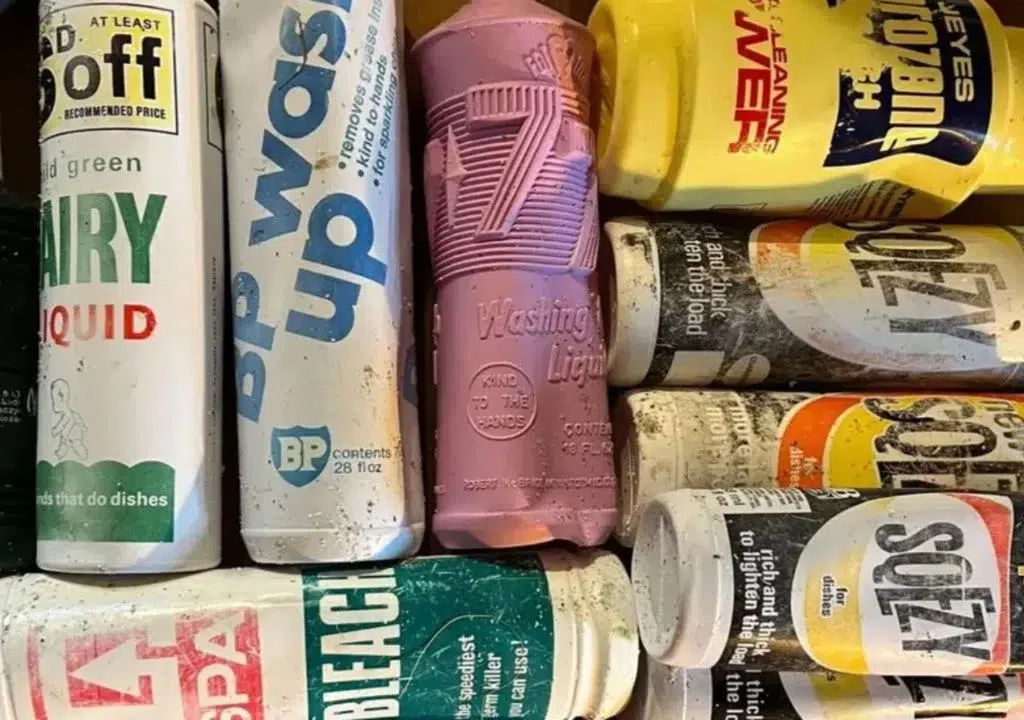
On Howar Sands beach, in the Orkney archipelago of Scotland, volunteers face an unusual scenario. Among the plastics were bottles and fragments with brands and dates that refer to the 1960s and 1970s.
The discovery turned a usual cleaning day into an environmental alert. What was once a manageable task became the collection of hundreds of objects and thousands of microfragments.
Additionally, part of the material has inscriptions suggesting distant origins, even from Canada. This confirms that waste can travel oceans for decades before reaching the shore.

Numbers that don’t add up and invisible microplastics
The organizers of the Sunday cleanups recorded an abrupt jump in the amount of trash. From just 42 bottles collected in 2025, the count rose to hundreds in 2026.
However, the biggest challenge is not the large containers, but the tiny particles. In just one square meter, thousands of polystyrene fragments were counted, difficult to remove and easy for birds and fish to ingest.
In an area of 70 square meters, more than 300,000 small pieces were estimated. This magnitude turns each cleanup into an unequal race against a problem that renews with each storm.
Storms, erosion, and historical garbage
Specialists attribute the phenomenon to extraordinary weather conditions. Strong southeast winds and seasonal storms can remove sediments and drag ancient waste to the coast.
The Marine Conservation Society warns that the erosion of coastal landfills also releases buried plastics from decades ago. Thus, materials considered “from the past” return to the marine circuit.
In Sanday, where Howar Sands is located, the concern goes beyond aesthetics. The beach is a site of special scientific interest due to bird nesting, so the presence of plastics poses direct risks to wildlife.
How long does it take for plastic to degrade?
One of the most disturbing aspects is the longevity of the material found. A common plastic bottle can take between 400 and 500 years to degrade, although it never completely disappears.
In the marine environment, plastic breaks down into microplastics due to the action of the sun and waves. However, these fragments persist and can enter the food chain. Expanded polystyrene, present in large quantities in Orkney, can disintegrate into millions of microscopic particles. These can remain for centuries in sediments and waters.
Therefore, the phrase “trash never disappears” takes on a scientific dimension. What is discarded today can return to the beaches within decades, driven by currents and storms.
Consequently, community cleanups are essential but insufficient without a global reduction in plastic consumption. The case of Orkney shows that the ocean has memory and that each piece of waste has a story that can resurface.



