



Although deforestation in the Brazilian Amazon has shown a decrease in recent years, another less visible phenomenon is advancing steadily: forest degradation. In just two years, this type of deterioration increased by 163%, affecting more than 25,000 km², according to recent data from scientific institutions in Brazil.
This process slowly erodes the health of forests, weakening their ability to capture carbon, regulate the climate, and sustain biodiversity. Unlike deforestation, which eliminates vegetation completely, degradation acts from within, altering the ecological balance.
66% of the degraded area was impacted by fires, many of which were caused by human activities such as agricultural burning, in a context exacerbated by prolonged droughts. Trees lose their resilience, and soils undergo alterations, compromising natural regeneration.
Meanwhile, the forest may appear intact from afar. But upon analyzing its species, soils, and internal structure, researchers detect a significant loss of functionality and recovery capacity.
 Amazon at risk due to deforestation.
Forest Degradation: Visible and Hidden Effects
The consequences of degradation in the Amazon are multiple and concerning. The emission of between 50 and 200 million tons of CO₂ per year makes this phenomenon a direct climate threat, similar to deforestation itself. Additionally, it alters rainfall patterns, crucial for agriculture and water supply in South America.
A degraded forest not only absorbs less carbon but also loses biodiversity: key species such as jaguars, tropical birds, or river dolphins are displaced or disappear. Regeneration in affected areas can take decades, and in many cases, the original ecosystem never returns.
Monitoring this degradation is a technical challenge. Unlike deforestation, it cannot always be detected by satellite. It requires high-resolution images, foliage analysis, and direct field observations, complicating the environmental response.
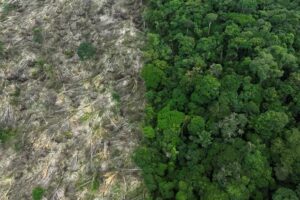 Amazon in danger due to deforestation.
Social Impact and Management Challenges
Indigenous and riverside communities living in the Amazon are the first to feel the effects of degradation. The loss of the forest jeopardizes their access to food, natural medicines, and protection against extreme events. Additionally, it increases their social and economic vulnerability, fueling forced displacements.
The lack of official records of degradation makes it difficult to design effective public policies. Faced with this scenario, experts recommend strengthening oversight, restoring damaged areas, implementing sustainable agriculture, and, above all, involving local communities in territorial surveillance.
Internationally, pressure is mounting. In preparation for COP30, Brazil must show tangible progress in restoration and emissions reduction to meet its environmental commitments and maintain global trust.
Amazon degradation is a silent threat that demands immediate attention. Acting today, with comprehensive and sustained measures, can make the difference between a resilient biome and one doomed to disappear. Preserving this ecosystem is not only Brazil’s responsibility but a global commitment to the planet’s future.



