



In the Andean mountain range, the cloud forests of northern Ecuador have revealed a new chapter for science. A team from the National Biodiversity Institute identified four species of frogs previously unknown to humanity. The discovery took place in the Mira River basin, a humid and biodiverse region that continues to surprise researchers.
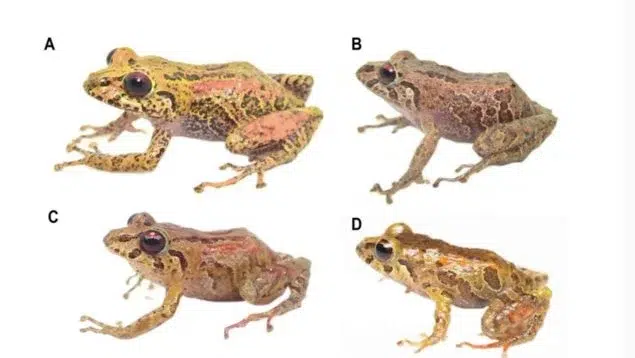
The discovered species, all from the genus Pristimantis, inhabit altitudes between 1,600 and 2,300 meters. Their names —P. praemortuus, P. broaddus, P. robayoi, and P. satheri— add to the inventory of a group adapted to cold and misty environments. These small amphibians do not rely on ponds or rivers, as they undergo direct development: their offspring are born as tiny frogs, without going through a tadpole stage.
Their behavior is discreet. They walk or climb calmly among damp leaves and moss, searching for insects and small invertebrates that form the basis of their diet. The night fog and high humidity are their allies to move without being detected. On average, they do not exceed 2.5 centimeters, but their variety of colors and patterns make them unique.
Researchers noticed remarkable differences in shades, markings, and finger shapes. Some display marbled bellies, others have golden irises with coppery reflections, or defined dorsal folds. These particularities, along with genetic analyses, confirmed that they were not just variations but completely new species.
Research and Biodiversity at Risk
The discovery was the result of expeditions carried out between 2015 and 2023 in areas such as the Dracula Reserve and the Cerro Golondrinas. By comparing the specimens found with museum collections from Ecuador and Colombia, the team identified enough differences to distinguish these amphibians from the lineage of Pristimantis verecundus.
In this region, more than 120 species of amphibians and reptiles have been documented, with a steady pace of new records. In the last ten years alone, seven new frogs have been described, and it is estimated that at least 15 more await their scientific confirmation. However, deforestation, agricultural expansion, and climate change are endangering their survival even before their ecological function is fully understood.
Conservation of these ecosystems is vital, not only for their scientific value but also for the role they play in environmental regulation. Frogs control insect populations and serve as indicators of forest health, making them natural allies against pests and sentinels against environmental degradation.

How Many Frog Species Exist?
The world of frogs is as vast as it is diverse. Scientists have identified about 7,500 species globally, although they estimate that there could be hundreds more uncataloged, especially in tropical regions and areas that are difficult to access. Their ability to adapt to different habitats —from deserts to cloud forests— has allowed them to occupy a wide range of ecological niches.
The Andes, due to their complex geography and natural isolation, have favored the evolution of unique species. Many of them are still waiting to be described, demonstrating that the biodiversity of this mountain range is a living resource that we are only beginning to explore. Protecting it is crucial so that future generations can discover and learn from these amphibians.
In a world where biodiversity loss is advancing rapidly, each new identified species is a reminder of how much there is left to explore and conserve. These frogs, though tiny, are key pieces in the web of life and in the natural memory of the Andes.


