



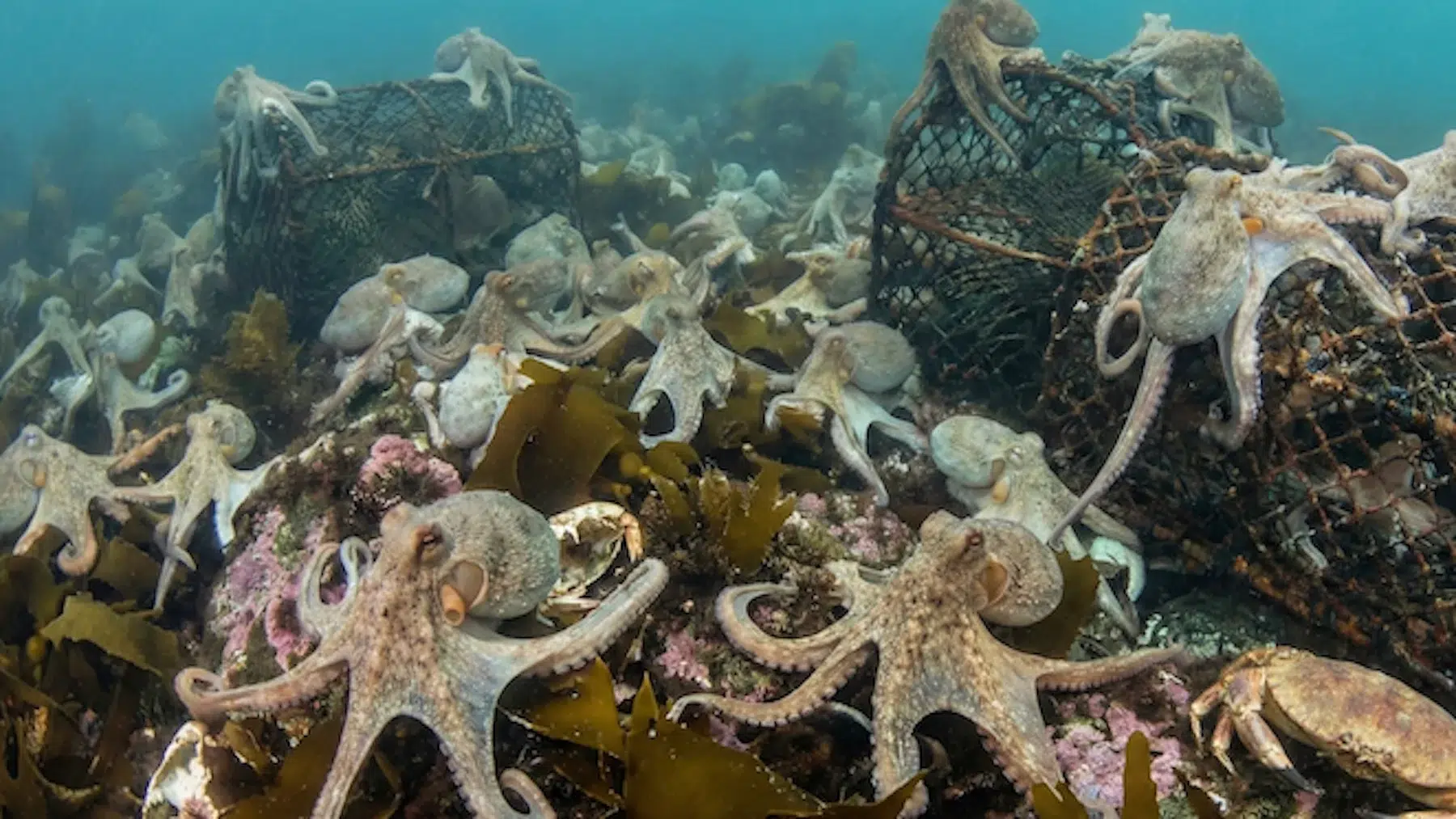
The coasts of Great Britain are experiencing an unprecedented phenomenon: the population of common octopuses (Octopus vulgaris) has reached record numbers and expanded from Devon and Cornwall to Scotland, with sightings in Wales, Dorset, and East Sussex.
The study led by Bryce Stewart, a researcher at the Marine Biology Association, confirmed that octopus catches increased by 7,700% in 2025, marking the largest documented proliferation in British waters.
Factors Explaining the Growth
Specialists attribute the phenomenon to a combination of environmental conditions:
- Mild winters and warm springs, which favor reproduction.
- Progressive warming of the sea, linked to climate change, creating a favorable environment for the species.
- Greater availability of food, facilitating the population’s expansion.
Stewart warned that “everything I see indicates that this is the largest proliferation we’ve seen; it’s very different.”
Impact on the Fishing Economy
The abundance of octopuses generates contradictory effects:
- Losses for shellfish fishermen: octopuses prey on crabs and lobsters, access traps, and reduce crustacean populations.
- Gains for other sectors: octopus sales reached a record 100 tons in a single day at the Brixham (Devon) market.
Stewart explained that “some fishermen have had to sell their boats due to the impact on crab and lobster populations, while others are doing extraordinarily well.”
Ecological Consequences
The proliferation alters the marine food chain:
- Octopuses prey on shellfish and fish.
- They become food for seals, conger eels, and Risso’s dolphins.
- They generate a “shake-up of the entire ecosystem,” according to Stewart.
This change forces a rethink of conservation and fishing exploitation strategies, as although the species is native, its current proliferation is unprecedented.
Civic Participation and Monitoring
The scientific community receives support from divers and snorkelers, who collaborate with reports and observations.
These data allow for more precise mapping of the species’ distribution and evolution, strengthening citizen monitoring as a research tool.
Debate on the Future
The increase of octopuses in British waters opens a debate on:
- Marine resource management.
- Adaptation of fishing practices to unforeseen scenarios.
- Influence of climate change on marine biodiversity.
As the British coast adapts to the new prominence of the octopus, the challenge is to balance ecological sustainability with the economic viability of the fishing sector.
The proliferation of octopuses in Great Britain is a phenomenon that reflects how climate change and environmental variations can radically transform marine ecosystems.
The challenge now is to design management policies that allow for the exploitation of the species’ abundance without compromising biodiversity or the traditional fishing economy.



