



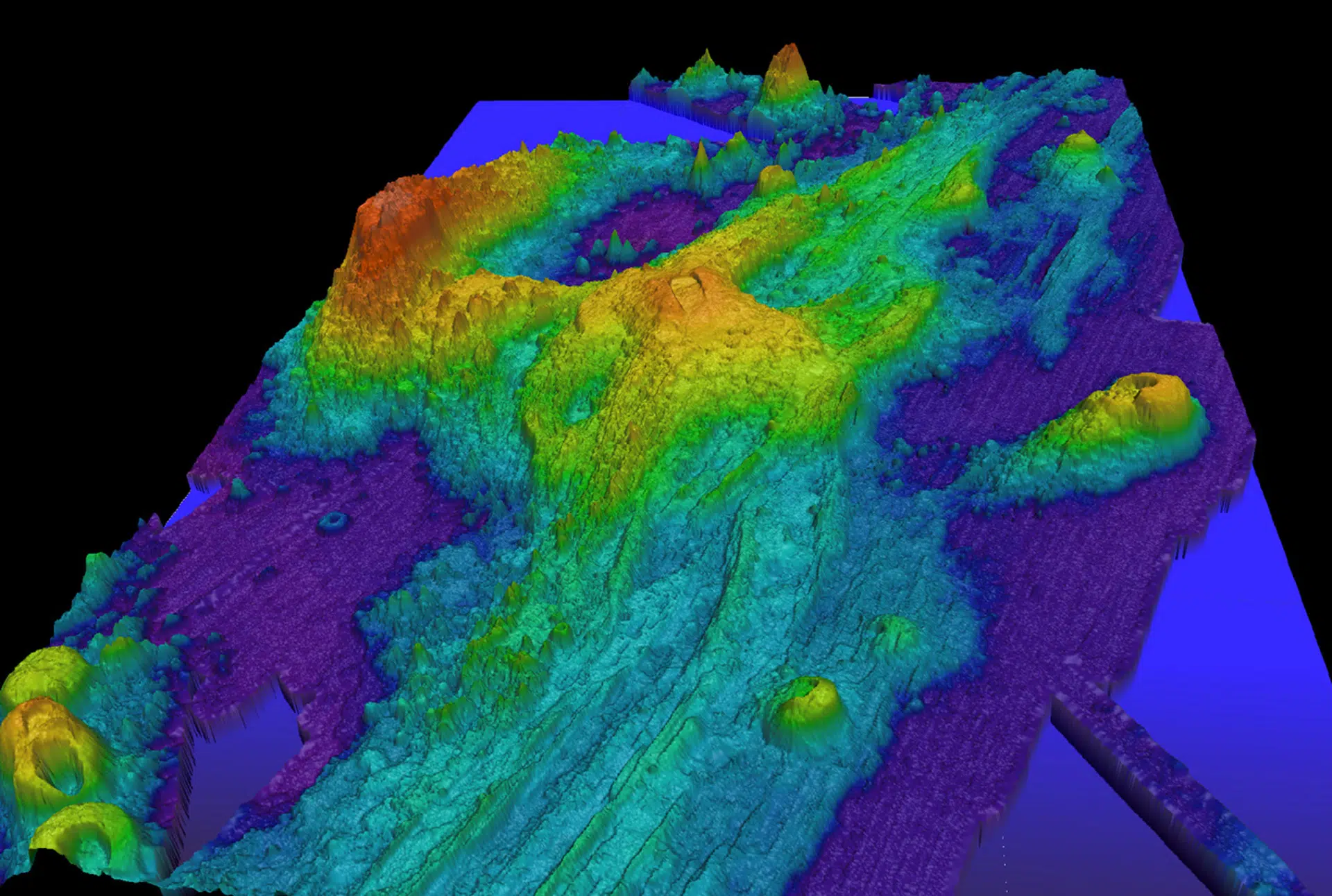
Located at over a thousand meters deep in the Pacific Ocean, off the northwest coast of the United States, the submarine volcano Axial Seamount has once again caught the attention of the scientific community after recording intense seismic activity.
Despite its remote location, this volcano poses a direct threat to marine ecosystems, raising alarms among researchers and environmental authorities.
A submarine volcano in constant motion: What makes it so special?
Considered the most active volcano in its region, the Axial Seamount is under constant surveillance by geophysicists and oceanographers.
Submarine eruptions, although less visible than terrestrial ones, can trigger earthquakes, tsunamis, and profound alterations in the seabed, depending on the magnitude and type of event.
Unlike other volcanoes that remain inactive for decades, this one maintains almost continuous activity, making it a natural laboratory to study geological processes in real time.
Over 2000 earthquakes in one day: signs of magmatic pressure
Geophysicists William Chadwick (Oregon State University) and Scott Nooner (University of North Carolina Wilmington) have closely monitored the behavior of the Axial Seamount.
In June, they detected a peak of over 2000 earthquakes in 24 hours, although since then the daily average stabilized around 100 events.
These variations in seismic frequency are indications of internal movements and accumulation of magmatic pressure, although experts clarify that there are still no clear signs of an imminent eruption. “The activity constantly fluctuates,” explained Chadwick, highlighting the difficulty of precisely predicting these types of phenomena, even with advanced technology.
Ecological impact: between devastation and marine resilience
Previous eruptions of the Axial Seamount occurred in 1998, 2011, and 2015, and the current activity suggests that the next one could be the most intense so far. Although the risk to human populations is low due to its depth and distance from the coast, the impact on marine fauna can be severe.
Oceanographer Deborah Kelley from the University of Washington recalled how in 2011 “a vent area was completely covered by lava.” However, she also highlighted the surprising resilience of these ecosystems: “Three months later, there were already animals and bacteria recolonizing the area.”
Real-time science: the value of continuous monitoring
The Axial Seamount is one of the few submarine volcanoes with permanent seismic monitoring, allowing scientists to anticipate changes and minimize damage. This thorough surveillance is key to understanding its internal dynamics and preparing conservation strategies for future eruptions.
Thanks to this scientific anticipation, it is expected that the ecological impact can be mitigated, protecting both marine biodiversity and human interests linked to fishing, research, and ocean health.


