



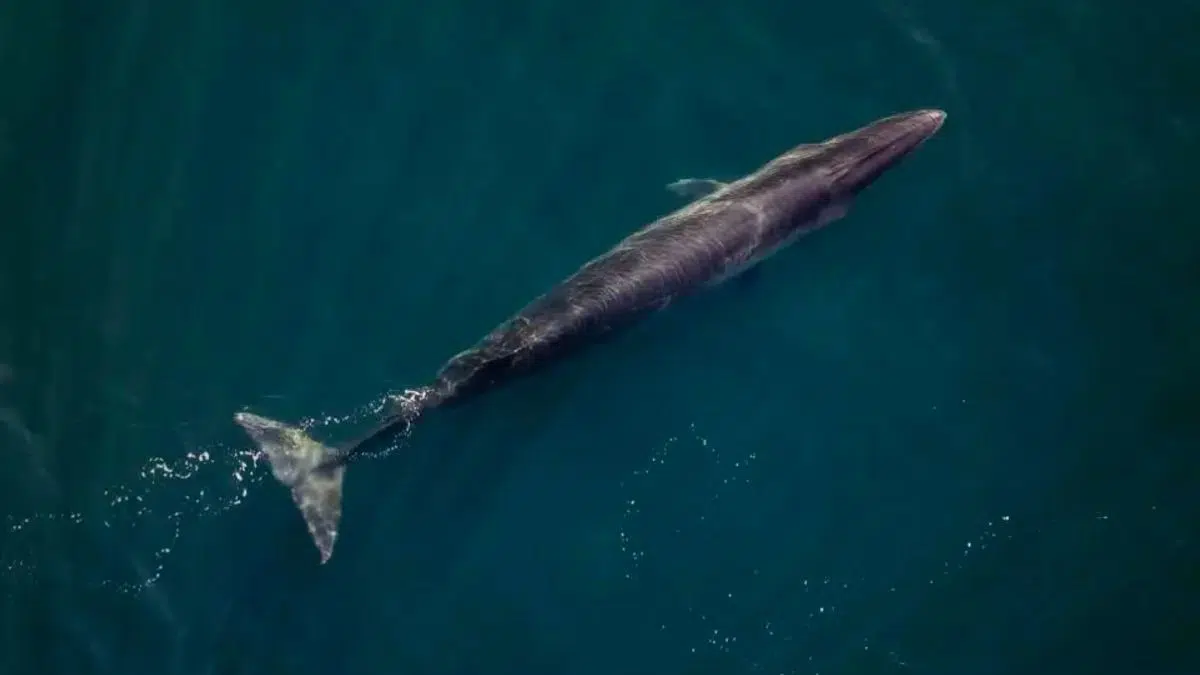
On the shores of the **Golfo San Jorge**, between **Comodoro Rivadavia** and **Rada Tilly**, an initiative that combines **scientific research, [marine conservation](https://noticiasambientales.com/medio-ambiente/argentina-adopta-las-omec-de-que-se-trata-la-nueva-herramienta-para-la-conservacion-marina-y-la-pesca-sostenible/)**, and tourism development began to take shape. It all started with an unusual phenomenon: the massive appearance of **cetaceans** in the region. Researchers from **CENPAT (CONICET)** and **UNPSJB** confirmed that they were **sei whales (Balaenoptera borealis)**, an endangered species, but with a **growing population**.
## Applied Science: Drones, Genetics, and Satellite Trackers
Systematic studies reveal migratory patterns and **feeding habits of sei whales**.
The team from **CESIMAR (CONICET)** and the **Faculty of Natural Sciences and Health** conducted **systematic sweeps**, incorporated **drones** and genetic **analysis** to identify the species. Then, through **aerial transects** and **satellite trackers**, they discovered that the whales come to the area to **feed on lobster**, a crustacean similar to lobster.
Between **November 2021 and May 2024**, up to **2,700 individuals** were recorded during the high season (April-June), in an area of **5,000 km²**, representing a **significant abundance** for a threatened species.
## Whale Watching Tourism: An Opportunity for Comodoro and Rada Tilly
**Local service providers join a project that seeks to diversify the regional economy**.
With the support of **local municipalities**, the **Chubut Ministry of Tourism**, and **private funding**, scientists began designing a **sei whale watching tourism product**. Four nautical service providers, originally focused on fishing and spearfishing, were **invited and incorporated into the project**, investing in **equipment, vessels, and training**.
“We want whale watching tourism to develop with a sustainable vision based on scientific evidence,” says **Mariano Coscarella**, a researcher at CESIMAR.
## Regulations, Environmental Impact, and Strategic Planning
Although service providers already have **provincial authorization for nautical tours**, specific **regulations** for sei whale watching still need to be implemented. The scientific team is working on **code of conduct guidelines** and the [**environmental impact assessment**](https://noticiasambientales.com/medio-ambiente/europa-avanza-hacia-el-fin-de-las-granjas-de-pieles-el-impacto-ambiental-y-social-de-una-industria-en-declive/), an essential requirement according to current legislation.
This project would allow for **extending whale watching tourism throughout the year**, as the **high season for sei whales (June-December)** does not coincide with that of the **southern right whale** in the Golfo Nuevo.
## Additional Attractions and Territorial Scientific Tourism
Due to the **strong winds** that limit navigation, whale watching could be done **every three days**. Therefore, work is being done on designing **complementary tourist circuits**.
Researcher **Federico Abbondio (IDEAus, CONICET)**, with provincial support, assesses **local capacities**, identifies **key actors**, and proposes **alternative activities** for days without navigation.
The proposal includes **Comodoro Rivadavia, Rada Tilly, Sarmiento**, and the **Interjurisdictional Coastal Marine Park Southern Patagonian**, with the aim of consolidating a **co-constructed scientific tourism model**, with a **territorial and sustainable focus**.



