



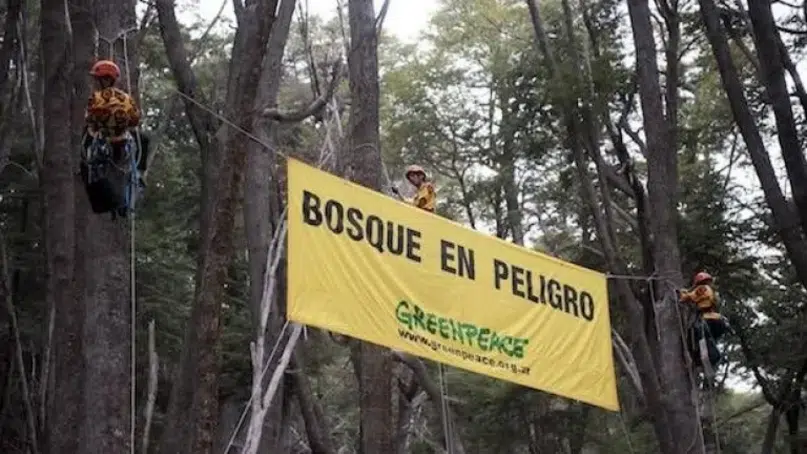
Deforestation is advancing in Salta and Greenpeace has once again protested against the province before the Supreme Court of Justice. The organization appeared before the highest court to challenge the Native Forest Zoning (OTBN).
This time, the environmental association included as a new fact the regulation of the controversial norm recently approved by the government of Gustavo Sáenz.
This is the second time Greenpeace challenges the new Salta zoning. In February of this year, when the Provincial Executive promulgated the law, the organization had already raised objections.
Now, after the regulation of this norm became known, the NGO reinforced its position by denouncing what it considers “a devastating blow to the forests“.

Main criticisms of the new Salta regulations
According to Greenpeace, the update of the Salta OTBN violates provisions of the National Forest Law 26.331.
In particular, it is denounced that the new zoning would enable deforestation in approximately 720,000 hectares of previously protected areas.
This figure is especially alarming considering that it is almost identical to the entire deforested area in the province in the last 15 years (714,052 hectares), according to official data.
Furthermore, the regulation would validate illegal deforestation already carried out without requiring environmental restoration tasks.
Deforestation in Salta: alarming first steps
The threat is not just a future projection, as the first step is already underway. The Sáenz government has already called for public hearings to authorize immediate deforestation on 30 estates totaling 25,916 hectares.
“The Sáenz government is moving towards legalizing an ecocide: it is about to authorize deforestation for 26,000 hectares and intends to relax the current provincial forest law. It does so in favor of large agricultural producers who want to continue clearing forests with total impunity,” said Noemí Cruz, coordinator of Greenpeace’s Forest Campaign, a few months ago.
Additionally, the activist highlighted a key point: “Argentina signed a commitment to Zero Deforestation by 2030 at the Climate Summit held in Glasgow in 2022. Provinces should move in that direction.”
According to the organization, among the companies and entrepreneurs benefiting from deforestation permits are: Agrodesmontes S.A., SILHER S.R.L., Antonio Ricardo Talavera, María Luisa Bracero, Campos del Trópico S.A., Alberto Cañizares, Rodrigo René Cuellar, José Ignacio Lecuona de Prat, and Joaquín Alejandro Paz Salazar, among others.
The “dark yellow” category: questioned flexibility
One of the most controversial points is the creation of the “dark yellow” category. This category allows the mobility of productive areas conditioned by deforestation percentages according to each watershed.
For Greenpeace, this classification represents a “disguised green” that allows “deforestation where it was not possible until today”.
The organization points out that these transitional categories are not provided for in Law 26.331. This implies flexible zoning without geographically determining where deforestation is precisely allowed or prohibited.
The yellow category covers a total of 5,528,753 hectares where the Salta government promotes Forest Management with Integrated Livestock (MBGI), also known as silvopastoral system. This methodology involves livestock breeding under forest cover.
Greenpeace warns that this system historically functioned as selective deforestation in provinces like Chaco and Santiago del Estero. This goes against what is established by the National Forest Law.
The organization believes that these precedents demonstrate that the practice will inevitably lead to progressive deforestation.

Deforestation in northern Argentina: its impact on jaguar conservation
In addition to deforestation, the association also warns about the territorial fragmentation that would affect large threatened mammals, particularly the jaguar.
The area affected by the new regulations largely coincides with the zone identified by scientists as critical for jaguar conservation.
Greenpeace concludes that the deforestation, degradation, and habitat fragmentation resulting from the application of the new OTBN will seriously endanger the survival of this emblematic species.
Another criticized aspect is the lack of prior consultation with indigenous communities, a process that should have been carried out according to current legislation.
<!– wp:


