



With the arrival of spring, the sky of Santa Fe fills with frenetic and free flights. They are the migratory swallows, tireless travelers who cover more than 8,000 kilometers from warm regions of the continental north, facing winds, rains, and storms.
Many do not manage to complete the journey, but thousands reach these plains, which for them are territory of refuge and reproduction.
Why do they choose Santa Fe?
Riverside environments, warmth, and abundant food turn the city into a temporary sanctuary.
Cold is the main enemy of these birds. In Santa Fe, they find temperate temperatures, riverside vegetation, and an inexhaustible source of food: flying insects, such as mosquitoes, dragonflies, and damselflies.
As explained by bird specialist Pablo Capovilla to the El Litoral portal, “it is impossible for them to go hungry in the mosquito capital.”
Diversity of species and nesting strategies
Three main species arrive to reproduce, while others visit without nesting.
The swallows that nest in Santa Fe are:
- Blue-and-white swallow (Progne chalybea): white chest, black wings, nests in artificial cavities
- Southern martin (Progne elegans): dark plumage, also nests
- Brown-chested martin (Progne tapera): uses abandoned ovenbird nests
Additionally, other species are observed such as the white-rumped swallow, present year-round, and the Chilean swallow, which arrives in winter seeking milder temperatures.
There are also smaller and harder-to-see species, such as the cinnamon teal, the scimitar-billed woodcreeper, and the cock-tailed tyrant, which do not nest but visit the city in spring-summer.
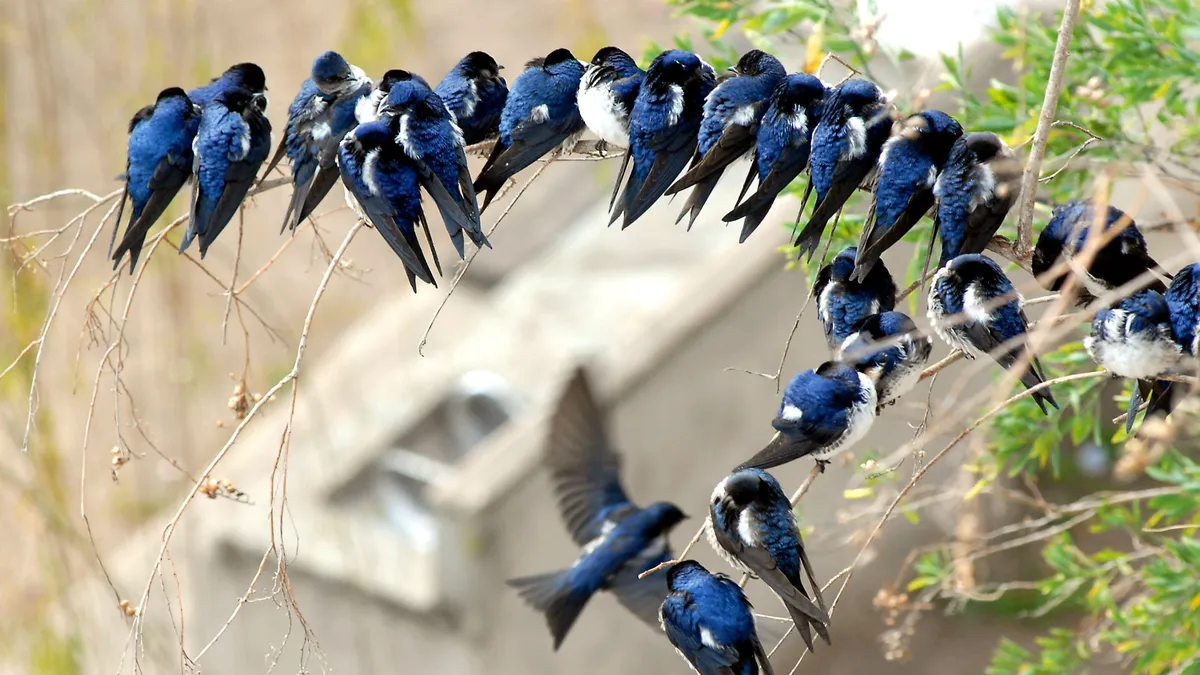
Ingenuity and urban adaptation
Swallows take advantage of human structures to raise their chicks.
From soccer goal frame pipes to lifeguard towers in Parque del Sur, the swallows demonstrate a remarkable ability to adapt.
“The rent is free, they just have to take good care of their chicks,” Capovilla jokes. Competition for the cavities is intense, and nesting marks the beginning of a life cycle that culminates with the return migration in March or April.
Recommendations for coexistence and conservation
Observe, respect, and offer safe spaces for nesting.
Capovilla recommends:
- Observe and enjoy their presence
- Do not remove ovenbird nests, which may be occupied by swallows
- Build nest boxes or tubes with pipes in patios or balconies
- Understand their ecological role as natural insect controllers
Birdwatchers Meeting: an invitation to look at the sky
From October 3 to 5, the Third Meeting will be held at Laguna El Cristal, Calchaquí.
Sponsored by the Ministry of Environment and Climate Change of Santa Fe, the event will bring together observers and specialists to explore new environments and share experiences. “Everyone is invited,” Capovilla concludes.
Contacts on Instagram: @pablo.h.capovilla @coachororo, @coacalandriarafaela; @aves_de_malabrigo.



