



The premiere of the documentary SEI, the Unknown Whale brings to the forefront one of the most impactful phenomena of the Argentine sea: the massive arrival of more than 2,500 Sei whales (Balaenoptera borealis) to the Golfo San Jorge, in the province of Chubut.
The Sei whale, the third largest animal on the planet, belongs to the group of rorquals and is in critical danger of extinction.
The film follows the research led by biologist Mariano Coscarella, from the Center for the Study of Marine Systems (CESIMAR-CONICET), along with specialists from the National University of Patagonia San Juan Bosco (UNPSJB) and the Patagonian National Center (CENPAT).
A historic sighting after almost a century
This group of Argentine researchers recorded the presence of the Sei whale on the Argentine Atlantic coast, marking its first sighting since 1929.
The documentary, produced by Jumara Films in collaboration with National Geographic Pristine Seas, was presented to more than 1,000 people in screenings held in Comodoro Rivadavia and Rada Tilly. It was also recently shown to 450 attendees at the Science Cultural Center (CONICET) in Buenos Aires.
A species decimated by intensive hunting
The Sei whale was absent for almost a century due to mass hunting, which reduced its population by 80% and left it endangered, according to the IUCN Red List.
During the 20th century, nearly 300,000 specimens were hunted and another 110,000 captured in the southern hemisphere, mainly to obtain fat used as fuel and industrial input. Although commercial hunting decreased with the arrival of oil, pressure on the species persisted in European seas until the 1970s.
Today it is estimated that only between 10,000 and 50,000 specimens remain worldwide, with poorly studied migratory habits and two recognized subspecies. The B. b. schlegelii in the southern hemisphere and B. b. borealis in the north.
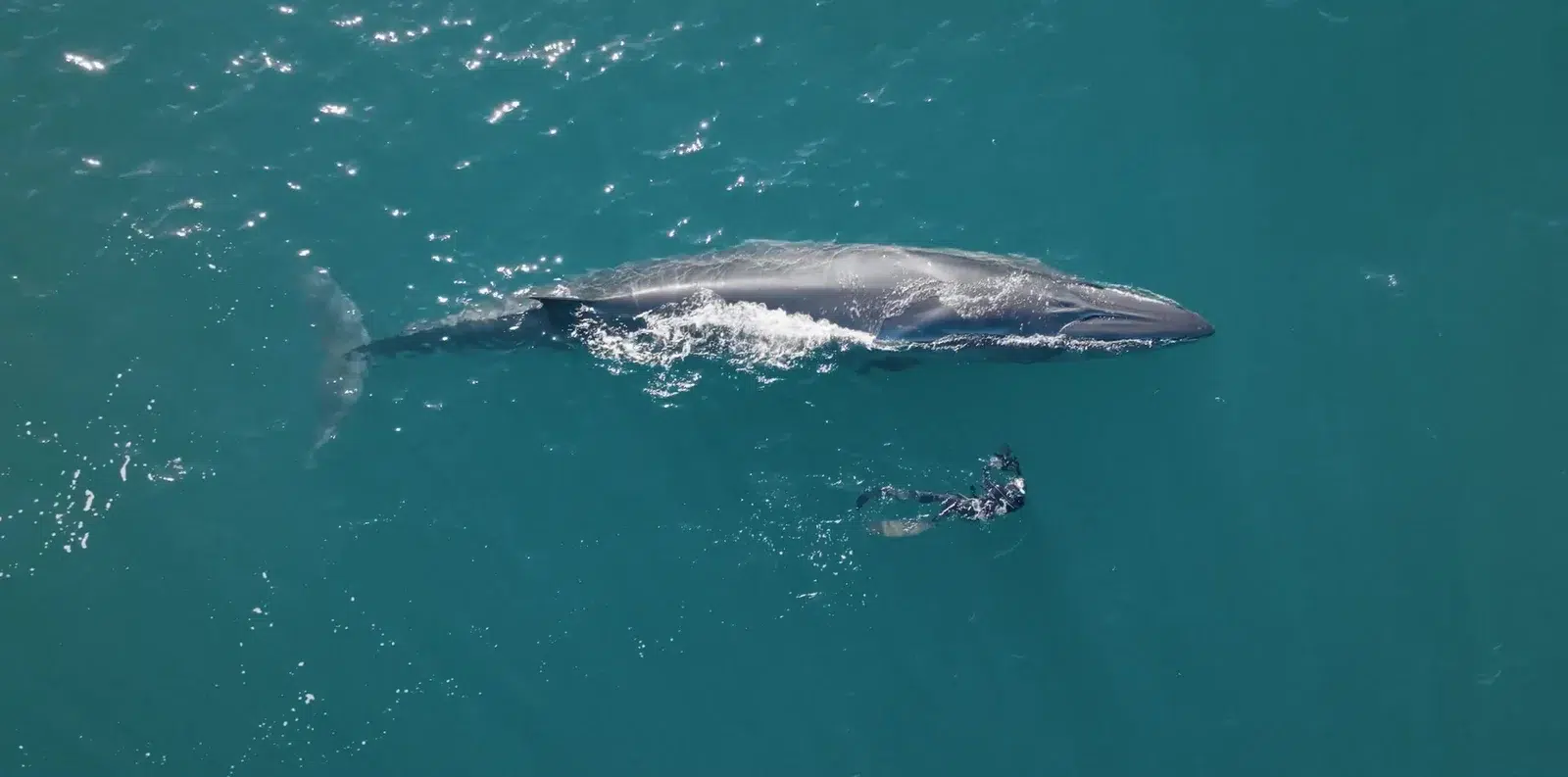
Science and technology to document their return
The return was initially detected by unusual breathing patterns between 2003 and 2004, and confirmed since 2019 through surveys in the Golfo San Jorge.
Coscarella’s team used drones and technical assistance from the Argentine Air Force, covering from Pico Salamanca to the south of Caleta Olivia. Genetic analyses confirmed the species and allowed for the estimation of sighting frequencies never before recorded in the region.
Characteristics of the Sei whale
- It can reach 18 meters in length and weigh more than 20 tons.
- Its diet is based on krill, crustaceans, and fish.
- It has a lifespan of between 50 and 70 years.
- Slender and fast, it is considered one of the fastest whales in the ocean.
Conservation and environmental education
Following recent surveys, the Sei whale was declared a Natural Monument in Chubut and the first management plan for responsible sighting was implemented, along with the expansion of the Punta Marqués Protected Area.
The documentary promotes the debate on the need to expand protection beyond the coastal strip and has a strong educational focus, with screenings and talks in schools, universities, and coastal communities, in collaboration with municipalities and the UNPSJB.
The documented return of the Sei whale is considered one of the most fascinating and hopeful phenomena for marine biodiversity in the South Atlantic. Its presence opens a new chapter in the region’s relationship with its natural environment, historically marked by the oil industry, and reinforces the importance of science and conservation as tools to protect the future of the oceans.


