



Bahamas declared the world’s first national park dedicated to seahorses in Sweetings Pond, an isolated lagoon on the island of Eleuthera.
The reserve protects one of the highest densities of Hippocampus erectus recorded and opens its waters to controlled night visits.
The National Park of the Seahorses received its official declaration in 2023.
This legal recognition protects an anchialine ecosystem that hosts exceptional concentrations of the species, far above the global average.
Bahamas: an isolated seahorse ecosystem
Sweetings Pond is an anchialine pond formed about 7,000 years ago.
It is isolated on the surface but connected to the sea through underground seepages and its maximum depth reaches 14 meters.
Thus, this isolation created unique conditions. Few predators access the pond and genetic exchange with the open ocean is scarce.

Therefore, the seahorses in this area of Bahamas developed distinct traits: longer snouts and different body patterns.
“Normally only a fragment is distinguished,” explained Heather Mason, marine ecologist and physiologist specializing in seahorses.
“A coiled tail, sometimes the snout. The rest blends with the environment. They are true masters of visual deception,” she added.
Nocturnal activity and bioluminescence
On the other hand, research revealed an intense nocturnal activity that had gone unnoticed for years.
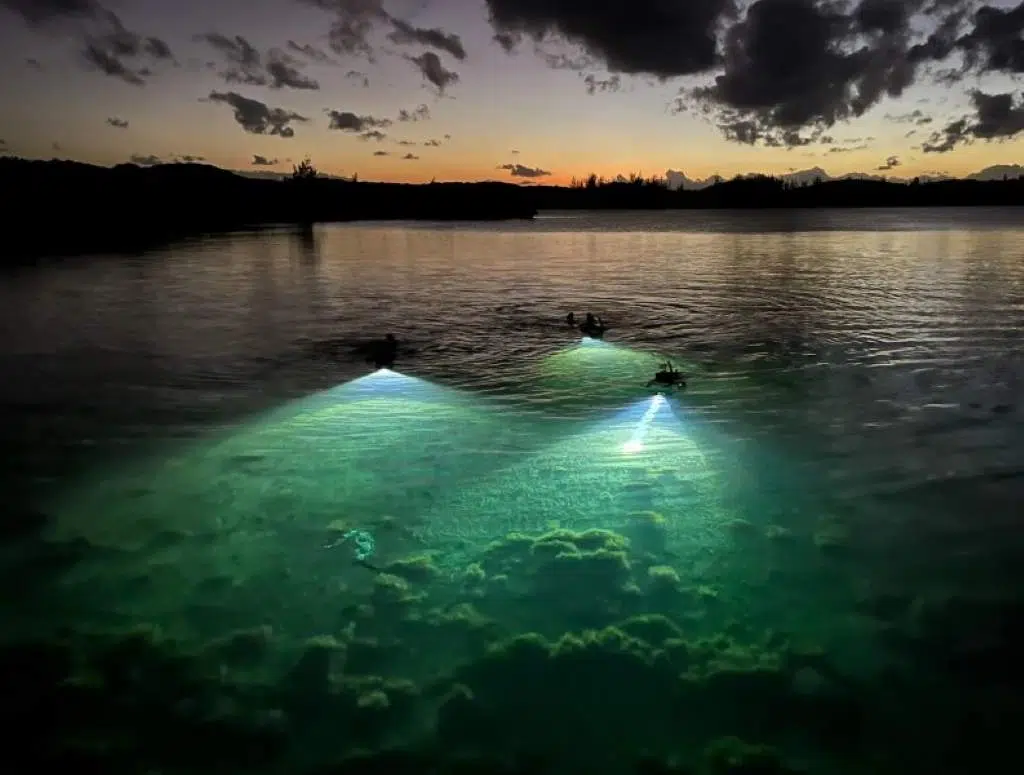
In this area of Bahamas, the seahorses emerge at nightfall, while the pond comes alive with octopuses, crabs, and flashes of bioluminescence.
Mason was studying dispersed populations in the Caribbean, used to locating one or two specimens per day.
In her first dive in Sweetings Pond, she counted 16 individuals. Subsequent investigations confirmed the exceptional densities.
The bioluminescent phenomenon turns every movement into a burst of light.
This behavior forced a rethinking of what was known about the species’ ecology in other parts of the world.
Limited ecotourism in Bahamas and scientific focus on seahorses
The legal protection posed the challenge of allowing access to the park, but without degradation. The response was caution: very few people, very few visits, a lot of control.
The only access operates through a pilot program developed with The Cove Eleuthera.
The Bahamas National Trust and Mason’s direct supervision ensure compliance with strict protocols for people entering:
- Maximum groups of six people
- Stays of four days starting in 2026
- Three visits to the pond: day and night
- Scientific talks and direct observation
- Income allocated to conservation and monitoring
During night dives, stirring up sediments poses a direct threat to the fragile ecosystem.
Therefore, visitors must move with extreme caution and use flashlights to avoid disturbing the bottom.
The park represents a natural laboratory without walls where evolution is observed in real-time.
The recent legal protection aims to ensure that this unique ecosystem remains intact in the long term.


