



An innovative yet simple invention developed in Hong Kong allows extending the lifespan of solar panels: it is a hydrogel coating.
This innovation managed to increase energy efficiency by 13% and reduce temperature by up to 16°C.
Researchers from the Hong Kong Polytechnic University created this economical solution that combats hot spots, one of the most persistent problems in urban photovoltaic installations.
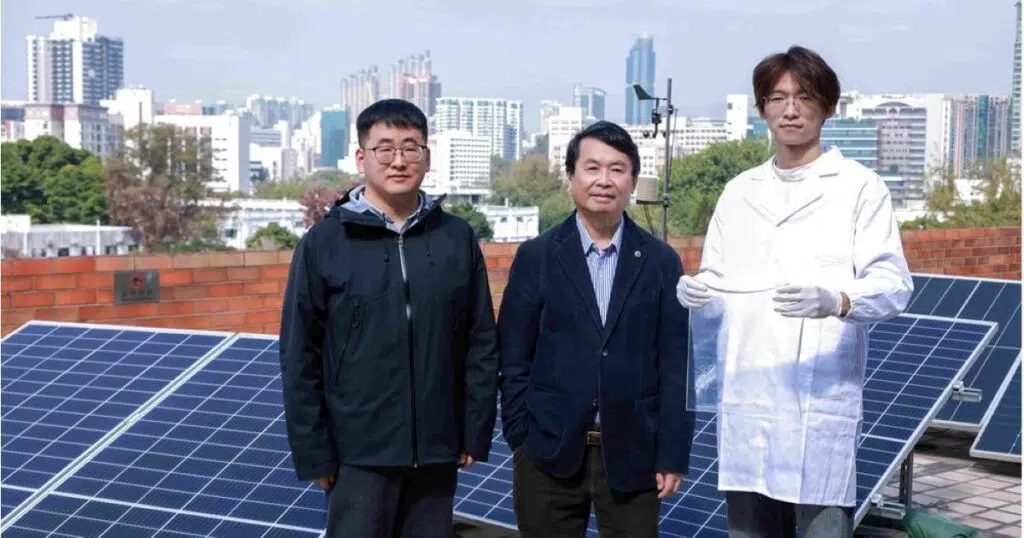
The technology, led by Professor Yan Jerry and Researcher Liu Junwei, is based on a simple principle.
Since the hydrogel retains water in its structure and then gradually releases it through evaporation, this process absorbs heat from the solar panels.
Thus, it allows them to reduce the temperature in areas most affected by radiation or uneven shading.
Less heat, more energy: the key of hydrogel in solar panels
The hydrogel for solar panels functions as a passive cooling system that does not require redesigning circuits or modifying the module’s structure.
It is applied directly onto already installed panels and works by removing heat through the evaporation of the contained water.
In controlled tests, the researchers observed temperature drops of up to 16°C in hot spots, accompanied by a power increase of up to 13%.
Thus, this improvement not only increases immediate energy production but also reduces thermal stress on photovoltaic cells.
This allows solar panels coated with hydrogel to last more years, with performance close to their original capacity and fewer modules ending up in premature recycling.
Thus, the cumulative effect protects the investment and improves the annual energy balance.
The impact of this innovation in dense cities
Building-integrated solar systems (BIPV) face particular challenges in urban environments: partial shading, dust, facades reflecting heat, and rooftops exposed to high temperatures.
All this generates hot spots that drag the rest of the system down.
According to estimates by the PolyU team, this hydrogel coating could increase annual production by about 6.5% in Hong Kong and 7.0% in Singapore.
Payback periods range between 3 and 5 years, depending on the local price of electricity.
The hydrogel technology fits especially well in solar panels installed on rooftops and facades of cities like Hong Kong or Singapore.
There, each percentage point of efficiency directly impacts decarbonization strategies.

The keys to hydrogel panels for solar panels: durable materials and low maintenance
One of the key advances of the project was solving the tendency of conventional hydrogels to crack or shrink over time.
To achieve this, the team combined a natural polymer (hydroxyethyl cellulose) with a fibrous structure known as leafy cotton thread.
The result is a material that better maintains its volume and integrity after months of exposure to sun, wind, and rain.
In this way, while some traditional hydrogels lose almost half of their volume, this new coating significantly limits that contraction.
Main benefits of hydrogel:
- Temperature reduction up to 16°C
- Efficiency increase of 13%
- Compatible with already installed panels
- Low implementation cost
- Greater durability of the photovoltaic system
It should be noted that hot spots not only reduce efficiency. Previous studies on millions of photovoltaic modules showed that a significant portion had thermal defects with temperature increases exceeding 21°C.
That extra heat accelerates the degradation of internal materials and can pose fire risks.
In public buildings, schools, or health centers, a 5% or 7% increase in annual production can free up resources for other services.
In homes, it makes the difference between covering only part of the consumption or approaching total self-consumption.
The integration of these hydrogels with new generations of photovoltaic panels, such as those based on perovskites, could solve one of their major challenges: sensitivity to heat and humidity.


