



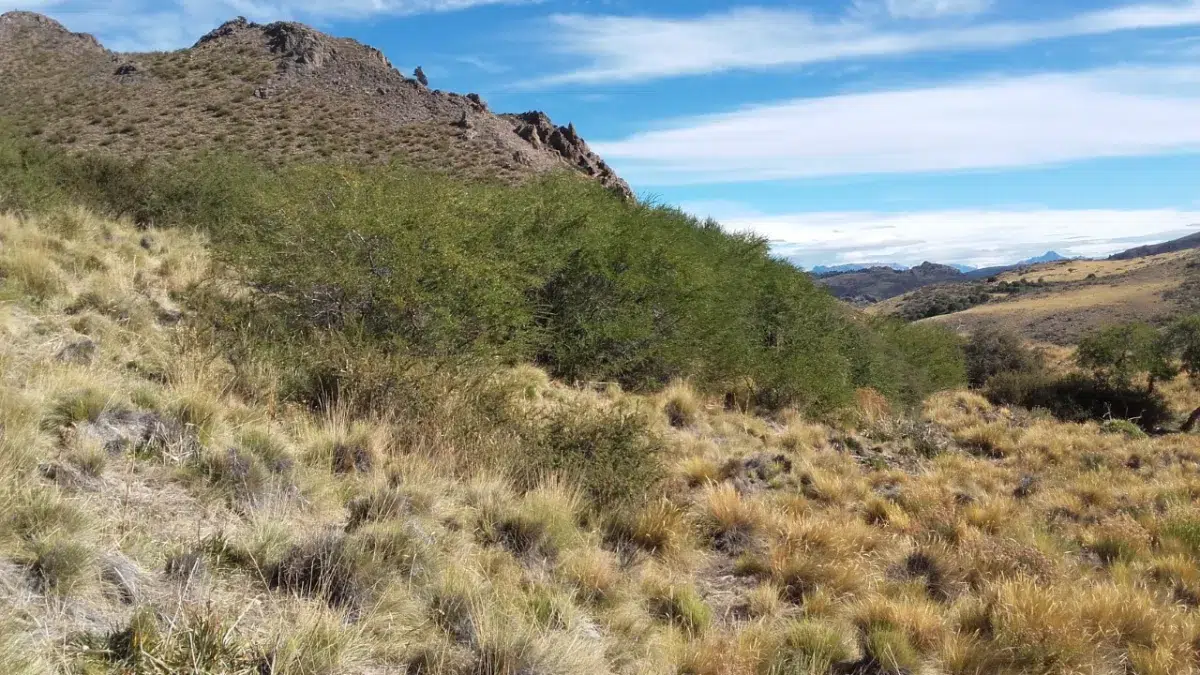
In the arid and semi-arid regions of the Argentine Patagonia, shrubs have been gaining ground while perennial grasses recede. Traditionally, this change was attributed to the increasing aridity and grazing pressure. However, two recent studies by the IPEEC-CONICET, published in Journal of Arid Environments, reveal an additional factor: allelopathy, that is, the release of chemical compounds by some plants into the soil that affect the germination and growth of others.
Experimental Evidence
The first study, led by Giovana Magalí Muñoz, demonstrated that typical shrubs of the Patagonian Monte, such as the jarilla (Larrea divaricata) and the molle (Schinus johnstonii), release soluble phenols into the soil through rain or dew leachates.
These compounds reduce the proportion of seeds that germinate and delay the process, decreasing the survival chances of grasses in environments where favorable conditions are scarce and brief.
Regional Analysis
The second work, led by Mónica Bertiller, expanded the scale of analysis along an aridity gradient in Patagonia. The results show that:
- The greater the aridity, the higher the proportion of shrubs compared to grasses.
- Higher concentrations of soluble phenols are recorded in the plant tissues of shrubs.
- In less arid areas, where shrubs have less active compounds, no significant allelopathic interactions were observed.
Grazing and Vegetation Dynamics
Grazing pressure is another key factor:
- Perennial grasses are highly consumed by herbivores due to their palatability, reducing their coverage and recovery capacity.
- Shrubs, on the other hand, have high concentrations of chemical compounds that make them less attractive for consumption, favoring their persistence and expansion.
Ecological and Productive Implications
The expansion of shrubs at the expense of grasses has direct consequences:
- Ecological: alters the structure of arid ecosystems, modifies resource availability, and affects biodiversity.
- Productive: reduces the quality of grasslands for livestock, impacting the regional economy.
- Chemical: introduces a new level of plant competition, where allelopathic compounds play a decisive role.
The studies by IPEEC-CONICET provide evidence that the dynamics between shrubs and grasses in Patagonia respond to a complex interaction of factors: water availability, grazing pressure, and chemical interactions between plants.
Understanding these processes is essential for designing management and restoration strategies in arid ecosystems, where small differences in competition mechanisms can have lasting effects on the landscape.


